By Newspot Nigeria Editorial Desk
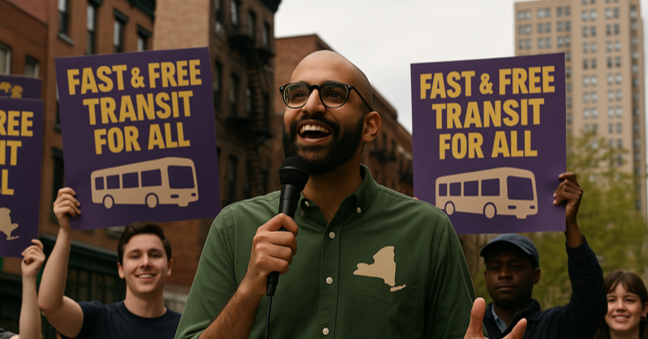
New York City mayoral hopeful Zohran Mamdani, a Democratic Socialist, has stirred citywide debate with his ambitious plan to make all public buses completely free. Supporters hail it as a bold step toward inclusive, sustainable mobility, while critics warn it could become a financial and administrative nightmare.
Mamdani argues that eliminating bus fares would make transportation fairer, faster, and more efficient—especially for low-income commuters who rely heavily on public transit. Research cited by The New York Times suggests such a policy could boost ridership by roughly 23%, adding up to 170 million extra trips each year. Advocates believe it would not only cut congestion but also reduce altercations between drivers and passengers, since there would be no need to collect fares or enforce payments.
Economist Charles Komanoff told NPR that fare-free buses could persuade more people to leave their cars at home, reducing carbon emissions and traffic. Scholars like Professor Amitrajeet Batabyal further argue that free transit would remove one of the biggest financial barriers for working-class residents, improving access to education, jobs, healthcare, and recreation while enhancing overall social inclusion.

However, the cost of such generosity remains the sticking point. Analysts estimate the plan would strip the Metropolitan Transportation Authority (MTA) of over $500 million in yearly revenue. Replacing that funding would likely require either raising taxes or diverting existing resources — both politically fraught moves. Governor Kathy Hochul has already made clear that increasing taxes on wealthy residents to pay for the program is off the table.





Critics also warn of potential downsides beyond finances. Some urban policy experts fear that fare-free buses could turn into “rolling shelters” if not properly managed, raising safety and sanitation concerns. Others worry that affluent New Yorkers might abandon the system altogether, leaving behind those most in need of reliable public transport.
Complicating matters further, New York’s transit system is state-run, meaning any major fare reform would require the cooperation of Albany lawmakers and the MTA board. That political reality could significantly limit a mayor’s power to implement such sweeping changes, no matter how popular they sound on the campaign trail.


Still, Mamdani’s proposal has injected fresh energy into the city’s transit conversation. It challenges traditional thinking about how urban transport should be funded and whom it should primarily serve. Whether or not the plan ever becomes law, it has already succeeded in reframing public debate around equity, efficiency, and the future of mobility in America’s largest city.
Newspot Nigeria notes that the discussion surrounding Mamdani’s proposal offers valuable insights for cities worldwide seeking to make public transportation both affordable and sustainable.