By Olugbenga Adebamiwa ( Newspot Political and Social Analyst)
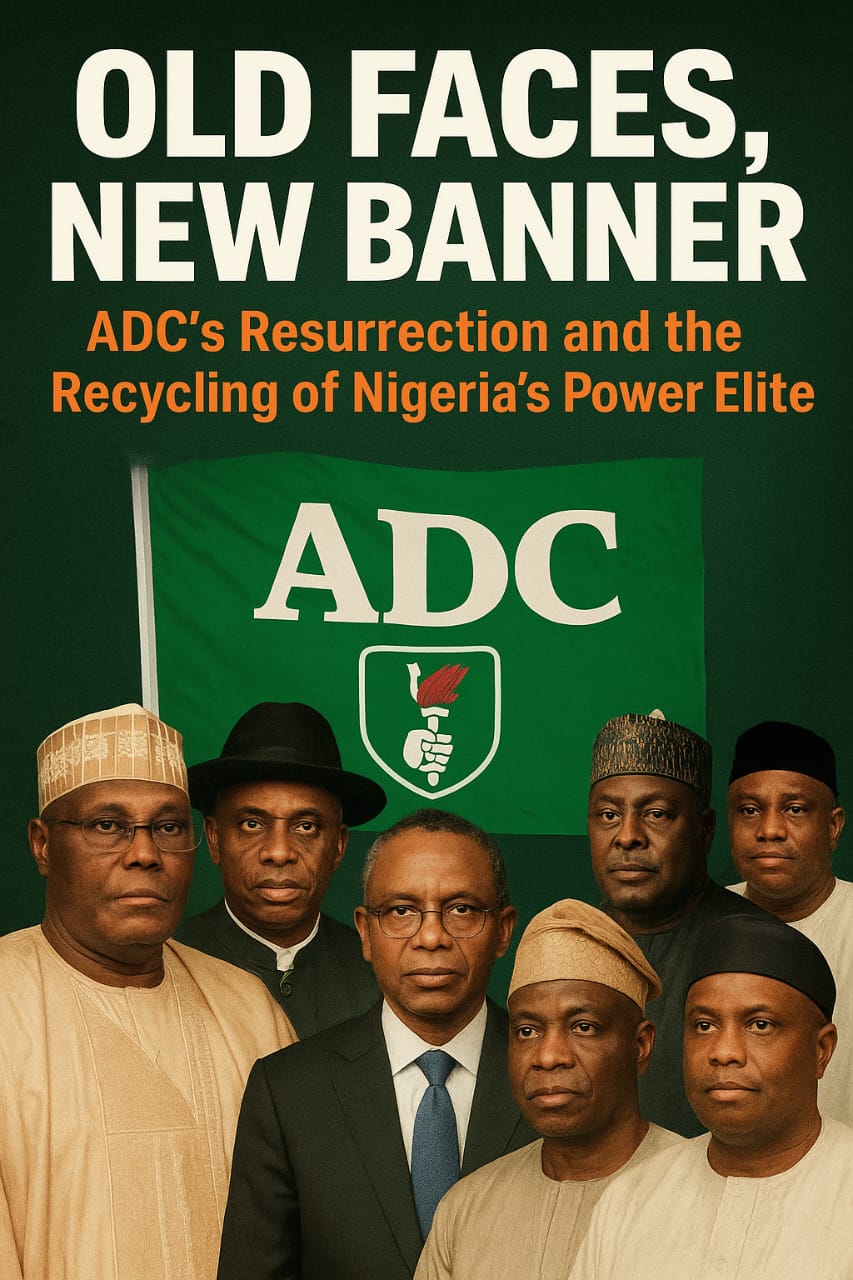
In Nigeria’s restless political theatre, the African Democratic Congress (ADC) has suddenly emerged from obscurity into prominence, not as a new movement for reform, but as a convenient refuge for disgruntled elites from the major parties, the PDP and APC. What was once a small and barely relevant political party has now become a coalition of old power brokers who once dominated Nigeria’s politics between 1999 and 2023. Their reappearance under the ADC banner is presented as an attempt to “save democracy” and “rescue Nigeria,” but a deeper look suggests a far more personal and self-serving motivation.
The ADC opposition coalition is grappling with legal battles, internal disputes, and public criticism that underscore the fragility of this new alliance. Atiku Abubakar accuses the government of targeting opposition figures, Rotimi Amaechi faces petitions over alleged unrest plots, and Nasir El-Rufai’s attacks on the Tinubu administration draw charges of hypocrisy. ADC leaders David Mark and Rauf Aregbesola are caught in court challenges over party leadership, Babachir Lawal rejected a cabinet role, Aminu Tambuwal was detained over alleged money laundering, and Peter Obi’s “Obidient” movement stirs internal tension. These controversies reveal legal uncertainty, fears of political persecution, and deep internal divisions, threatening the coalition’s stability ahead of the 2027 elections.
The ADC, founded in 2005 and registered by INEC in 2006, originally prided itself on ideals of transparency, inclusivity, and reform. For nearly two decades, however, it remained on the fringes, winning no governorships, securing only one seat in the House of Representatives, and serving mostly as a platform for minor candidates. Yet by 2025, it has become the epicenter of Nigeria’s opposition movement, attracting Atiku Abubakar, Rotimi Amaechi, David Mark, Rauf Aregbesola, Babachir Lawal, Nasir El-rufai and other prominent figures who were once pillars of the same political order they now criticize. This sudden shift raises an essential question, is this a new dawn for Nigeria’s democracy, or merely a recycling of old ambitions under a new name?

Many of these politicians argue that their gathering under the ADC is driven by patriotic concern, a determination to prevent Nigeria from sliding into one-party dominance under President Bola Tinubu. They point to the concentration of political power within the APC as a threat to democratic balance. Yet, their own track records reveal a striking contradiction. Between 1999 and 2023, most of them occupied the highest offices in the land, from the presidency to the legislature and the federal cabinet. They presided over the same systems of patronage, corruption, and exclusion that they now denounce. It is difficult to see their movement as a crusade for reform when they were the architects of the very structures they claim to oppose.





At the center of this coalition is Atiku Abubakar, the perennial presidential aspirant and former vice president, whose repeated bids for power span both PDP and APC platforms. Now described as the “ring leader” of the ADC realignment, Atiku insists that his return to the arena is about rescuing Nigeria’s democracy. Yet, insiders and analysts see a familiar pattern, another calculated move to secure political relevance after losing influence in the PDP. Alongside him stands David Mark, the veteran ex–Senate President who now serves as the ADC’s interim national chairman, and Rauf Aregbesola, the former APC governor and minister who fell out with Tinubu after internal party feuds. Their new alliance, despite public posturing, is marred by mutual distrust and clashing ambitions.
The internal dynamics of the ADC already mirror the political chaos its leaders left behind. The Atiku–Obi rivalry, a continuation of the 2023 opposition split lingers beneath the surface. While Peter Obi has not formally joined the ADC, his supporters have criticized Atiku’s dominance in the coalition. Reports suggest that Atiku’s camp has seized control of much of the party’s structure, from the National Working Committee to state chapters. This has sparked growing fears that the ADC will soon degenerate into yet another arena for elite infighting rather than a genuine platform for democratic renewal.


Critics also highlight the moral and ideological emptiness of the new ADC movement. Beyond political talks about democracy and good governance, the coalition has yet to present a credible policy vision. Its spokesmen speak of “saving Nigeria,” but rarely articulate how they intend to fix the economy, tackle insecurity, or reform institutions. Instead, the party seems preoccupied with positioning itself as the “anti-Tinubu” front, uniting more by resentment than by a shared ideology. Observers describe it as a coalition driven by “bile and bitterness,” not conviction, a gathering of men seeking redemption for their lost power rather than restoration for the nation.
Ironically, President Tinubu’s administration has become the common enemy that unites this unlikely alliance. Many of the defectors were sidelined, investigated, or politically displaced during his early reforms and restructuring of the APC. Their defection to the ADC thus appears less a principled stand than a retaliatory maneuver, an attempt to reclaim relevance by building an alternative power base. The ruling party has derided the move as a “marriage of strange bedfellows,” a label that resonates with many Nigerians who view the coalition as opportunistic rather than transformative.
In truth, the ADC’s resurgence is a mirror held up to Nigeria’s political culture, one defined by personal ambition, not ideology. Rather than a contest of ideas, it remains a game of shifting loyalties, where yesterday’s power brokers reinvent themselves as tomorrow’s reformers. If the ADC is to become more than a refuge for political exiles, it must prove that it stands for something beyond self-preservation. Otherwise, history will remember this moment not as the rebirth of opposition, but as yet another chapter in the endless recycling of Nigeria’s political elite.
©️ Adebamiwa Olugbenga Michael