
By Olugbenga Adebamiwa ( Newspot Political and Social Analyst)


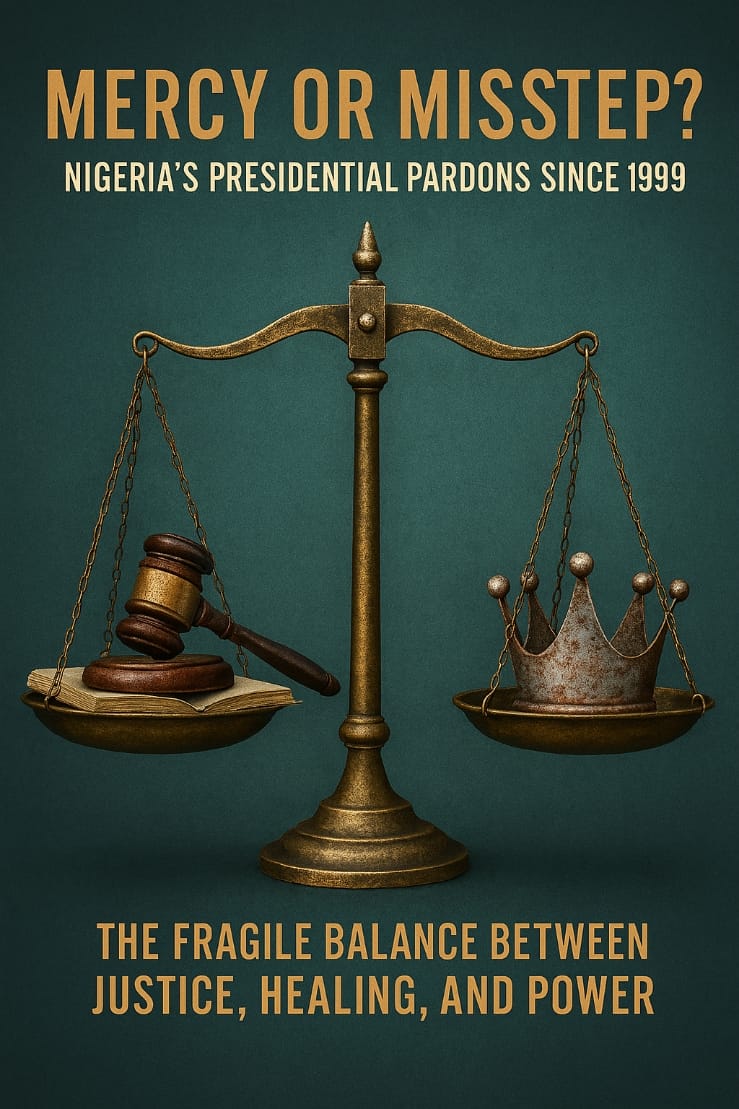
From Obasanjo to Tinubu, Nigeria’s presidential pardons reveal a delicate dance between mercy, politics, and justice. As President Bola Ahmed Tinubu’s 2025 clemency for 175 convicts sparks national debate, the country is once again confronted with an age-old dilemma, how to balance compassion with accountability in a system where trust in justice remains fragile. This analysis traces how presidential mercy has evolved, and at times, been exploited across two decades of Nigerian democracy.
Since Nigeria’s return to civilian rule in 1999, presidential pardons have stood at the intersection of justice and politics, promising national healing but often delivering controversy. Enshrined in Section 175 of the 1999 Constitution, the power of clemency allows the President, upon the advice of the Council of State, to pardon, remit, or commute sentences. While conceived as a tool for compassion and reform, it has frequently mirrored political realities, exposing the tension between moral conscience and political calculation.
In principle, clemency affirms a humane justice system, one that believes in rehabilitation and forgiveness. In practice, it often reflects shifting loyalties and strategic interests, turning an act of mercy into a mirror of political convenience. Each administration since 1999 has used this power differently, revealing how Nigerian leaders interpret justice through the lens of politics, legacy, and public sentiment.

Former President Olusegun Obasanjo (1999–2007) used pardons to heal wounds from years of military rule. His release of General Oladipo Diya, imprisoned under Abacha for an alleged coup, and the posthumous pardon of Shehu Musa Yar’Adua were hailed as gestures of reconciliation. Yet critics accused him of selective justice, overlooking lesser-known political prisoners while favoring prominent allies. Obasanjo’s clemency thus set an early precedent where forgiveness was both a moral act and a political signal.





Umaru Musa Yar’Adua (2007–2010) adopted clemency as a strategy for peacebuilding. His 2009 Niger Delta Amnesty Programme, freeing and rehabilitating over 26,000 militants helped end years of pipeline sabotage that crippled oil exports. The move earned him global praise for practical governance, but it also created moral ambiguity, many saw it as rewarding violence. Billions spent on stipends and training did little to secure lasting peace, exposing how mercy without reform risks breeding entitlement.
Goodluck Jonathan (2010–2015) expanded the scope of presidential pardons but faced fierce backlash. His 2013 pardon of Diepreye Alamieyeseigha, a former governor convicted of money laundering, sparked international outrage. Transparency International condemned it as “a setback to Nigeria’s anti-corruption fight.” Jonathan defended his decision as an act of reconciliation, but it reinforced a perception that clemency in Nigeria too often protects the powerful rather than corrects judicial overreach.


President Muhammadu Buhari (2015–2023) entered office as an anti-corruption reformer but soon faced the familiar dilemma. His government’s mass pardons such as the 2020 COVID-19 prison decongestion of 2,600 inmates were justified on humanitarian grounds. Yet, the 2022 pardon of former governors Joshua Dariye and Jolly Nyame, both convicted of corruption, drew condemnation. Civil society groups like SERAP called it “a betrayal of justice,” arguing it eroded the credibility of anti-graft institutions and demoralized honest public servants.
President Bola Ahmed Tinubu (2023–2025) has tried to redefine clemency through a mix of historical justice and humanitarian relief. His decision to grant 175 pardons in October 2025 included symbolic gestures toward national reconciliation, posthumously recognizing figures like Herbert Macaulay, Mamman Vatsa, and the Ogoni Nine. These acts were praised as long-overdue acknowledgments of injustice, particularly by groups like MOSOP. Yet, critics insist that genuine justice for the Ogoni Nine demands exoneration, not forgiveness, a cautious but significant distinction.
Tinubu’s 2025 clemency list, which included 29% drug offenders, 14% illegal miners, and controversial names like Maryam Sanda (convicted of murder) and Kelvin Oniarah (a kidnap kingpin), reignited fierce debate. Supporters hailed it as evidence of a humane presidency, detractors called it reckless and politically motivated. Observers highlighted an apparent regional leaning, with about 40 – 50% of drug-related clemencies granted to individuals from the Southeast zone, a move some view as a gesture of inclusion, while others see it as potentially controversial. interpreted by some as a gesture of reconciliation, and by others as a politically risky move that could weaken law enforcement credibility.
Opposition voices, including Atiku Abubakar, described the mass pardon as “a dangerous reward for criminality,” while APC loyalists defended it as part of Tinubu’s “renewed hope” philosophy. The controversy underscores a broader question, can mercy coexist with accountability in a country where corruption and impunity remain systemic? In the absence of transparent criteria, every pardon risks being viewed through the viewpoint of politics rather than justice.
Across 26 years of democracy, Nigeria’s clemency record exposes a recurring duality, half inspired by genuine compassion, half tainted by convenience. From amnesty for militants to pardons for corrupt politicians, the moral pendulum has swung between unity and hypocrisy. With corruption still endemic (Nigeria ranked 145th of 180 countries in Transparency International’s 2024 index), the cost of poorly explained mercy is increasingly high.
Public trust in the justice system has eroded. According to Afrobarometer’s 2022 report, 55% of Nigerians distrust the judiciary, and presidential pardons often deepen that skepticism. Social media reactions to Tinubu’s 2025 clemency, with over 10,000 posts under #TinubuPardon, revealed a divided nation, some viewing the act as restorative, others as another elite privilege that mocks justice.
Nigeria’s democracy stands at a crossroads. If clemency is to serve its true constitutional purpose, reforms are essential. Legal experts propose that future pardons exclude corruption, violent crime, and terrorism, and require public disclosure of reasons and victim consultation. Mercy must not be arbitrary, it must be principled, consistent, and transparent. When guided by justice, clemency can heal a nation. But when wielded as a political instrument, it risks turning forgiveness into favoritism, and mercy into a mockery of justice.
© Adebamiwa Olugbenga Michael