By Newspot Nigeria News Desk
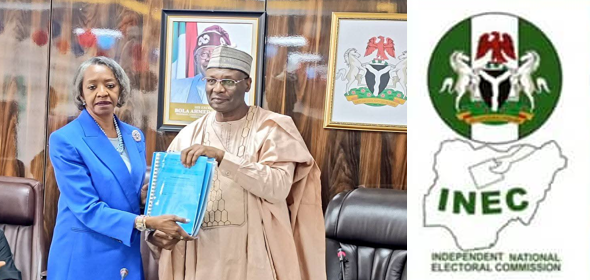
As Nigeria prepares for another critical democratic transition in 2027, the recent exit of Prof. Mahmood Yakubu from the Independent National Electoral Commission (INEC) and the appointment of May Agbamuche-Mbu as Acting Chairperson mark a turning point for the country’s electoral future.
After nearly a decade at the helm, Prof. Yakubu’s tenure leaves behind a mixed legacy — one characterized by both institutional innovation and operational controversy, especially following the widely criticized 2023 general elections. Now, as Acting Chairperson, May Agbamuche-Mbu steps into a position burdened with high expectations and even higher stakes.
A Legacy of Innovation, But Questions Remain
Under Prof. Yakubu, INEC introduced notable reforms, most prominently the Bimodal Voter Accreditation System (BVAS) and the INEC Result Viewing Portal (IReV) — technologies aimed at curbing fraud, improving transparency, and restoring electoral integrity.

However, the implementation of these reforms was inconsistent, particularly during the 2023 elections, where technical failures, delayed uploads of results, and allegations of result tampering significantly undermined public trust in the process.





For many observers, the 2023 elections represented a step backward in democratic consolidation, despite the promising tools at INEC’s disposal.
Enter May Agbamuche-Mbu: A Chance for Redemption?
With the mantle of leadership now resting on May Agbamuche-Mbu, a long-serving National Commissioner at INEC, Nigeria finds itself at a pivotal crossroads. Her appointment comes at a time when electoral credibility is at its lowest in recent history, and the 2027 general elections loom on the horizon.


Agbamuche-Mbu brings legal expertise, experience in electoral administration, and institutional knowledge. Yet, her greatest challenge lies not in operational familiarity but in restoring credibility, confidence, and independence to INEC.
To do so, her leadership must focus on:
- Institutional Neutrality: Shielding INEC from executive and partisan interference.
- Operational Efficiency: Ensuring timely deployment of logistics and consistent use of BVAS and IReV.
- Transparency: Publishing comprehensive post-election audit reports and engaging the public in reform processes.
- Stakeholder Inclusion: Deepening partnerships with civil society, the media, political parties, and the electorate to co-create solutions.
2027 in Focus: The Window is Narrow
With just over a year before major preparations for the 2027 general elections must begin in earnest, INEC’s new leadership has a limited window to initiate meaningful reforms. These reforms cannot wait for the last minute — electoral credibility is not achieved on election day; it is built over time through planning, transparency, and consistent public engagement.
Civil society actors, such as FENRAD, have already called for a comprehensive electoral audit and the establishment of a clear roadmap for 2027, addressing the lapses of the previous cycles. These demands must not be ignored.
This transition at INEC must be more than a change of face; it must be a change in direction. The Nigerian electorate cannot endure another cycle of broken promises and botched polls.
Conclusion: A Test of Leadership and Will
As Acting Chairperson, May Agbamuche-Mbu now carries the responsibility of rebuilding a fractured institution and leading it toward a more transparent and credible 2027 election. Her performance in the coming months will determine whether INEC can reclaim its constitutional role as an impartial umpire or further erode what little trust remains.
Prof. Mahmood Yakubu’s exit marks the end of a controversial era. What Nigeria needs now is not just continuity, but courageous leadership, clear vision, and uncompromising integrity — qualities that will define whether the 2027 elections are free, fair, and truly reflective of the people’s will.
📝 Original Statement
From: Comrade Nelson Nnanna Nwafor
A Public Policy Analyst, Development Consultant, Good Governance Campaigner, and Human Rights Activist
📞 Tel: 08033383708, 07062949232
📧 Email: [email protected] | [email protected]
The Exit of Prof. Mahmood Yakubu and the Emergence of May Agbamuche-Mbu: Charting a Credible Electoral Pathway Towards 2027 General Elections
As Nigeria prepares for another critical democratic transition in 2027, the recent exit of Prof. Mahmood Yakubu from the Independent National Electoral Commission (INEC) and the subsequent appointment of May Agbamuche-Mbu as Acting Chairperson mark a turning point for the country’s electoral future.
After nearly a decade at the helm, Prof. Yakubu’s tenure leaves behind a mixed legacy one characterized by both institutional innovation and operational controversy, especially following the widely criticized 2023 general elections. Now, as Acting Chairperson, May Agbamuche-Mbu steps into a position burdened with high expectations and even higher stakes.
Under Prof. Yakubu, INEC introduced notable reforms, most prominently the Bimodal Voter Accreditation System (BVAS) and the INEC Result Viewing Portal (IReV) — technologies aimed at curbing fraud, improving transparency, and restoring electoral integrity. However, the implementation of these reforms was inconsistent, particularly during the 2023 elections, where technical failures, delayed uploads of results, and allegations of result tampering significantly undermined public trust in the process.
For many observers, the 2023 elections represented a step backward in democratic consolidation, despite the promising tools at INEC’s disposal.
With the mantle of leadership now resting on May Agbamuche-Mbu, a long-serving National Commissioner at INEC, Nigeria finds itself at a pivotal crossroads. Her appointment comes at a time when electoral credibility is at its lowest in recent history, and the 2027 general elections loom on the horizon.
Agbamuche-Mbu brings legal expertise, experience in electoral administration, and institutional knowledge. Yet, her greatest challenge lies not in operational familiarity but in restoring credibility, confidence, and independence to INEC.
To do so, her leadership must focus on:
- Institutional Neutrality: Shielding INEC from executive and partisan interference.
- Operational Efficiency: Ensuring timely deployment of logistics and consistent use of BVAS and IReV.
- Transparency: Publishing comprehensive post-election audit reports and engaging the public in reform processes.
- Stakeholder Inclusion: Deepening partnerships with civil society, the media, political parties, and the electorate to co-create solutions.
With just over a year before major preparations for the 2027 general elections must begin in earnest, INEC’s new leadership has a limited window to initiate meaningful reforms. These reforms cannot wait for the last minute. Electoral credibility is not achieved on election day — it is built over time through planning, transparency, and consistent public engagement.
Civil society actors, such as FENRAD have already called for a comprehensive electoral audit and the establishment of a clear roadmap for 2027, addressing the lapses of the previous cycles. These demands must not be ignored.
This transition at INEC must be more than a change of face; it must be a change in direction. The Nigerian electorate cannot endure another cycle of broken promises and botched polls.
As Acting Chairperson, May Agbamuche-Mbu now carries the responsibility of rebuilding a fractured institution and leading it toward a more transparent and credible 2027 election. Her performance in the coming months will determine whether INEC can reclaim its constitutional role as an impartial umpire or further erode what little trust remains.
Prof. Mahmood Yakubu’s exit marks the end of a controversial era. What Nigeria needs now is not just continuity, but courageous leadership, clear vision, and uncompromising integrity — qualities that will define whether the 2027 elections are free, fair, and truly reflective of the people’s will.
Published by Newspot Nigeria
📍 For verified political analysis and national updates, visit www.newspotng.com