By Prof Abiodun Ojo
Nigeria’s oil and gas sector was once again in the spotlight this week as long-standing criticisms of union practices resurfaced amid an industrial dispute with the privately-owned Dangote Refinery.
For decades, the country’s three state-owned refineries in Port Harcourt, Warri, and Kaduna have remained largely unproductive, despite billions spent annually on turnaround maintenance. During those years of inactivity, the Petroleum and Natural Gas Senior Staff Association of Nigeria (PENGASSAN) and the National Union of Petroleum and Natural Gas Workers (NUPENG) rarely mounted visible protests against the Nigerian National Petroleum Company Limited (NNPC) over the refineries’ inefficiencies.
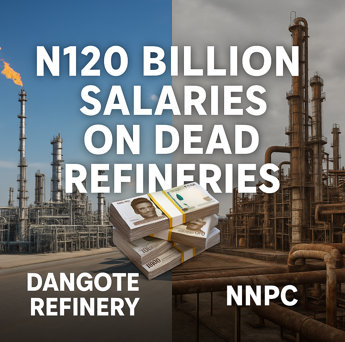
Instead, fresh allegations suggest the unions themselves benefited from the moribund system. Public commentator Obiareri alleged that PENGASSAN and NUPENG members were drawing as much as ₦120 billion yearly in salaries linked to the non-functional refineries. He described the arrangement as a monumental waste that enriched workers while impoverishing the nation.
“It is shameful that salaries and union dues kept flowing on dead refineries, yet the same unions are now attacking a private enterprise that is functional and meeting national needs,” Obiareri remarked.
The allegation has not been independently verified. No official government audit or investigation has confirmed the figure, and neither PENGASSAN nor NUPENG has issued a formal rebuttal. Analysts, however, say the claim—if proven—highlights why transparency in refinery operations and union activities must be urgently addressed.





From Silence on NNPC to Picketing Dangote
Observers note that while the unions largely kept quiet during years of waste under the NNPC, they swiftly mobilised protests against the Dangote Refinery following the disengagement of about 800 workers.
The refinery, which began operations as Africa’s largest privately-owned oil processing facility, has been lauded for breaking decades of dependence on fuel imports. Critics argue that comparing Dangote Refinery to government refineries is misplaced. As a private establishment, it operates under a different model—similar to private universities or hospitals, which are not unionised in the same manner as public institutions.


FG Steps In, Brokers Peace
The escalating dispute, which sparked fears of fuel supply disruptions, prompted the Federal Government to intervene. The Ministry of Labour and Employment convened a high-level meeting involving Dangote Group, union leaders, and government officials.
At the end of the conciliation talks, both sides reached a truce. Key resolutions included:
- Redeployment of affected workers within other Dangote Group subsidiaries without loss of pay.
- No victimisation of workers for union activities during the dispute.
- Suspension of strike action, with PENGASSAN agreeing to begin a return to industrial peace.
The government hailed the outcome as a “major breakthrough” that safeguarded national economic stability. PENGASSAN, for its part, assured members that their rights would remain protected while pledging to engage constructively with management going forward.
Looking Ahead
The latest episode exposes deep contradictions in Nigeria’s oil and gas labour politics. While Dangote Refinery has emerged as a rare symbol of functionality in a sector plagued by waste, the unions’ posture has raised uncomfortable questions about accountability, vested interests, and the real priorities of organised labour.
For millions of Nigerians, the truce comes as a relief. But the bigger debate remains: why did the unions overlook years of state refinery rot, only to confront a private refinery striving to keep the nation’s energy wheel turning?
Until there is full disclosure on the ₦120 billion salary claim and greater transparency in union activities, this question will continue to echo in the minds of citizens.