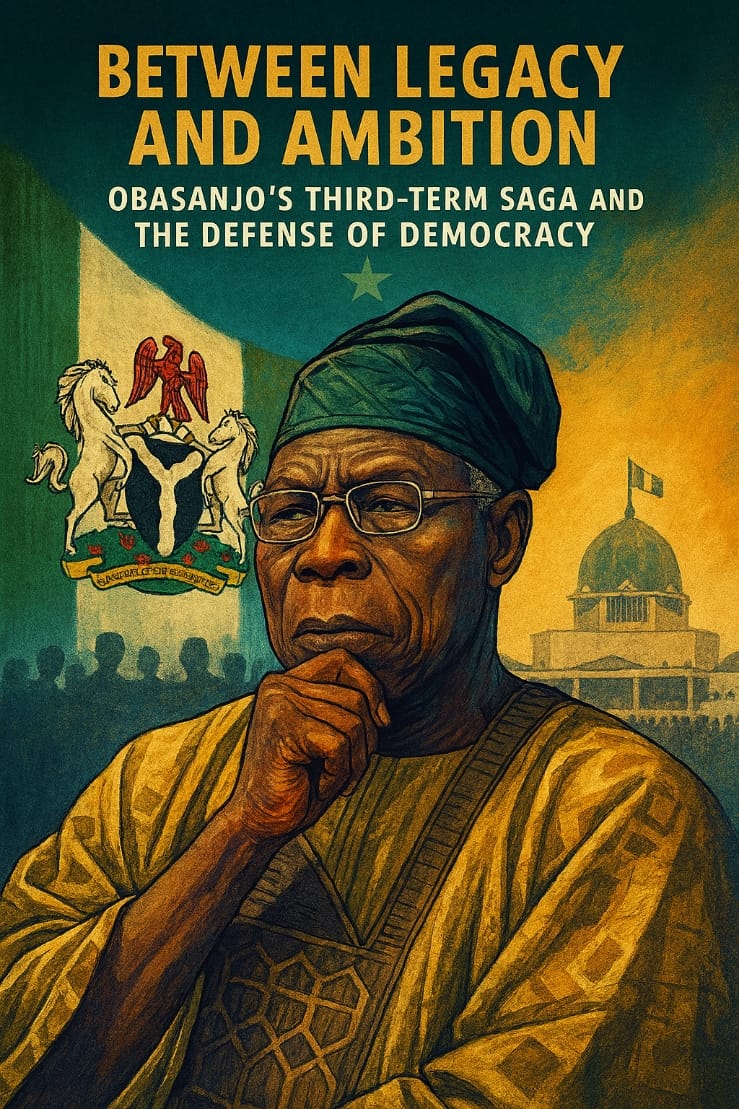
Few episodes in Nigeria’s democratic history have stirred as much controversy, speculation, and enduring debate as the alleged third-term bid of former President Olusegun Obasanjo. Nearly two decades on, the saga continues to provoke questions about personal ambition, institutional resilience, and the delicate balance between leadership continuity and constitutional limits.
Obasanjo assumed office in 1999, ending decades of military rule and ushering Nigeria into a fragile democracy. His administration pursued economic reforms, debt relief, and anti-corruption measures. Yet, by 2005–2006, as his second term drew to a close, whispers of a constitutional amendment to extend presidential and gubernatorial tenures began circulating, sparking debates over democratic norms and the dangers of “sit-tight” leadership.

Supporters argued that Nigeria’s nascent democracy needed stability and continuity. Extending the president’s term, they claimed, would consolidate reforms and maintain progress. Critics, however, saw the proposal as a thinly veiled attempt to entrench power, undermining constitutional safeguards and echoing authoritarian tendencies familiar across parts of Africa.





Obasanjo has consistently denied any personal ambition for a third term. “If I wanted a third term, I would have gotten it. I am audacious enough to know how to get it,” he said. He maintains that the push was driven primarily by governors seeking their own term extensions rather than himself, framing the episode as a misattribution of political maneuvering.


Former Vice President Atiku Abubakar and other figures claim credit for halting the bid. Atiku asserts that his close relationships with National Assembly members were crucial in defeating the amendment. Muhammadu Buhari, then in opposition, is also credited with galvanizing resistance, while former allies of Obasanjo reportedly rejected the proposal in a pivotal Villa meeting, signaling fractures within the political elite.
The climax came on May 16, 2006, when the Senate decisively rejected the constitutional amendment. Lawmakers’ defiance was hailed as a victory for democracy. Allegations of bribery and financial inducements including claims that hundreds of millions of dollars were deployed to sway votes added drama and fueled perceptions of state resources being exploited for political gain.
The failure of the third-term bid catalyzed political realignments. The PDP fractured, relationships between Obasanjo and Atiku soured irreparably, and the selection of Umaru Yar’Adua as successor perceived as a manageable candidate reflected the lasting influence of the presidency over party politics.
Human rights lawyers Chidi Odinkalu and Ayisha Osori documented alleged expenditures of $500 million to advance the bid. Though unproven in court, these claims reinforced concerns about governance and the ethical use of public resources. The episode remains a case study in the intersection of money, power, and politics in Nigeria.
Just recently at a public function in Accra Ghana, Obasanjo once again addressed the controversy, denying personal ambition and warning against overstay in office, calling it a “sin against God.” While some interpreted his statements as candid, others questioned his audacity, highlighting the enduring tension between his denials and the historical narrative.
The episode has left an indelible mark on Nigerian political consciousness. Social media, news outlets, and academic commentary frequently revisit the saga, debating whether Obasanjo was a restrained democrat or a leader whose ambition was tempered only by institutional resistance.
Nigeria’s 2006 third-term crisis underscores the importance of constitutional safeguards, the independence of legislative bodies, and the vigilance of civil society. Across Africa, the temptation to amend constitutions for extended rule remains prevalent, but Nigeria’s resistance serves as a rare success story of democratic institutions holding firm.
Obasanjo’s third-term saga exemplifies the duality of leadership, the potential for nation-building alongside the temptation of power consolidation. Whether his denials are sincere or strategic, the episode highlights the precarious balance between ambition and principle, and the enduring scrutiny leaders face long after leaving office.
Ultimately, the third-term bid remains symbolic, a reminder that democracy requires vigilance, that institutions can resist personal ambition, and that history often judges leaders not only by their achievements, but by the temptations they face and the choices they make when power is within reach. Obasanjo, whether hero, near-miss autocrat, or both, remains inseparably tied to this critical chapter in Nigeria’s democratic evolution.
©️ Adebamiwa Olugbenga Michael