By Queen Amina Mohammed
Introduction
Poverty is widely misunderstood as simply a lack of money. In truth, it is a condition that not only denies access to resources but also imposes disproportionate costs on those who can least afford them. The paradox is stark: the poor often pay more for basic necessities, while the wealthy access goods, services, and opportunities at cheaper rates. This phenomenon — sometimes called the “poverty premium” — reveals structural injustices that deepen inequality and perpetuate cycles of deprivation.
As Francis Bacon famously asserted, “Knowledge is power.” Knowledge, resources, and access are currencies of survival. Their absence does not simply diminish life’s quality; it magnifies life’s costs.
The Paradox of Poverty Costs
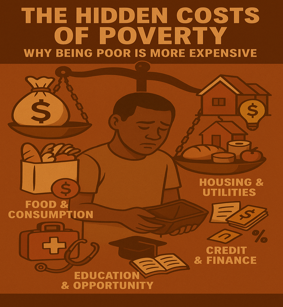
1. Food and Consumption
Research shows that low-income families spend up to 30% more on staple goods because they are forced to buy in small, frequent quantities rather than in bulk (World Bank, 2016). In developing countries, the poor rely on informal markets where food is often more expensive per unit. Poor nutrition then drives higher long-term health costs, especially among children.
2. Housing and Utilities
The poor are trapped in endless rental cycles, paying more over decades than homeowners who build equity. Energy poverty compounds this: without efficient appliances or access to stable power grids, low-income households pay more for electricity, kerosene, and fuel. According to the International Energy Agency (2022), poorer households spend up to 20% of their income on energy, compared to less than 5% for the wealthy.




3. Healthcare
Preventive healthcare is often inaccessible, leading to delayed treatment. Amartya Sen’s Development as Freedom (1999) highlights how the lack of access to health services reduces human capability and perpetuates economic vulnerability. Medical emergencies among the poor often result in catastrophic out-of-pocket expenses, trapping families further in poverty.
4. Credit and Finance
Economist Joseph Stiglitz has argued that inequality is reinforced through financial exclusion (The Price of Inequality, 2012). The poor depend on exploitative moneylenders with high interest rates, while the wealthy secure low-cost loans and benefit from investment opportunities and tax incentives. Poverty thus becomes not just a lack of cash but a denial of fair financial access.


5. Education and Opportunity
UNESCO (2021) reports that children from the poorest households are five times more likely to be out of school than those from wealthy families. Education is a long-term escape from poverty, but when the poor cannot afford quality schooling, they are denied upward mobility. This locks families into intergenerational poverty.
The Hidden Taxes of Poverty
The “poverty premium” is an invisible tax. It punishes the poor for their lack of resources and keeps them trapped in cycles of dependency. Poverty is not only about scarcity but about structural injustice: society makes the poor pay more for less.
This aligns with Bacon’s insight: without access to knowledge, tools, and opportunity, people are stripped of power and forced to survive under conditions that make life costlier. Poverty is therefore not merely an economic state — it is a condition of systemic disempowerment.
Social and Policy Implications
The cost of poverty extends beyond individuals to society at large:
-
Healthcare systems are overwhelmed by preventable diseases.
-
Economic productivity is stifled when millions are excluded from education and innovation.
-
Social unrest emerges when inequality hardens into injustice.
Policy responses must dismantle the structures that make poverty expensive:
-
Expand financial inclusion through microcredit and fair banking.
-
Invest in universal healthcare and preventive services.
-
Ensure affordable education and skills training.
-
Build affordable housing and energy infrastructure.
-
Regulate predatory lending and exploitative informal markets.
Conclusion
The statement, “People don’t know how expensive it is to be poor,” is not a metaphor — it is a lived reality for billions worldwide. Poverty is not cheap; it extracts hidden costs in money, time, health, dignity, and opportunity. To ignore this paradox is to allow inequality to deepen unchecked.
As Bacon reminds us, knowledge and access are the foundations of power. Until systems are restructured to give the poor equal access to opportunities and resources, poverty will remain not only a condition of lack but also a trap of perpetual expense.
References
-
Bacon, F. (1597). Meditationes Sacrae and Human Philosophy – “Knowledge is Power.”
-
Sen, A. (1999). Development as Freedom. Oxford University Press.
-
Stiglitz, J. (2012). The Price of Inequality. W.W. Norton & Company.
-
World Bank (2016). Poverty and Shared Prosperity.
-
UNESCO (2021). Global Education Monitoring Report.
-
International Energy Agency (2022). World Energy Outlook.