
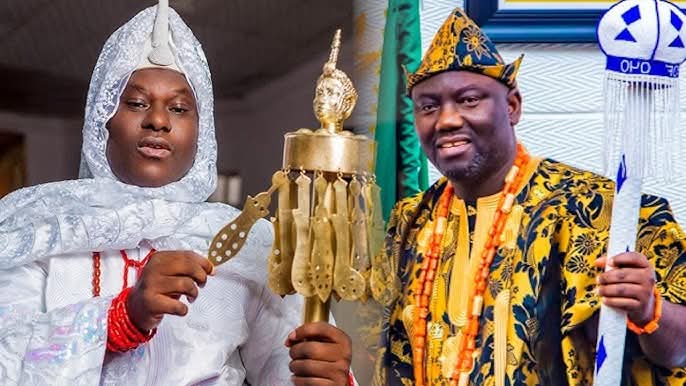
The ongoing dispute between the Alaafin of Oyo, Oba Akeem Owoade, and the Ooni of Ife, Oba Enitan Ogunwusi, has reignited debate over the delicate balance of authority within Yorubaland’s traditional institutions.


The controversy began when the Alaafin issued a 48-hour ultimatum demanding that the Ooni revoke the Okanlomo of Yorubaland title conferred on Chief Dotun Sanusi, a prominent Ibadan businessman and philanthropist. The title was bestowed during the unveiling of the 2geda social media and business networking platform at Ilaji Hotel, Ibadan.

The ultimatum drew a sharp response from Ibadan stakeholders, who described it as “an affront on Ibadanland.” Leaders of the Ibadan Mogajis and Baales argued that the Ooni acted within his authority and noted that the title was first conferred years ago without objection from the late Alaafin, Oba Lamidi Adeyemi III.




Mogaji Asimiyu Ariori, President of the Association of Mogajis of Ibadanland, and Mogaji Nurudeen Akinade of the Ibadan Compound Peace Initiative (ICPI), jointly defended both the Ooni’s decision and Chief Sanusi’s status. They stressed that Sanusi’s elevation to Jagun Olubadan in 2023 places him in line for future succession to the Olubadan throne, and thus, any attack on him amounts to an attack on Ibadan’s dignity.


Beyond defending Sanusi, the Mogajis questioned the timing of the ultimatum, calling it unnecessary provocation. They recalled that the late Alaafin not only coexisted peacefully with Sanusi but openly celebrated his contributions to Ibadanland and Yorubaland.
The dispute reflects a long-standing rivalry between the stools of Oyo and Ife.
In March 2024, a video from First Lady Oluremi Tinubu’s event showed the Alaafin seated while other monarchs stood to greet the Ooni.
In June, both rulers appeared to avoid each other at the West African Economic Summit in Abuja.
A similar quarrel occurred in 1991 when the late Alaafin Adeyemi protested against the late Ooni Sijuade over a Yoruba-wide title conferred on Chief Tom Ikimi.
This repeated friction points to deeper issues of jurisdiction and precedence within the Yoruba traditional system.
The Alaafin’s camp insists that only the Oyo throne has the authority to confer Yoruba-wide titles, citing a Supreme Court ruling. They argue that the Ooni’s jurisdiction is limited to Ife and surrounding local governments.
But other voices disagree. The pan-Yoruba socio-political group, Afenifere, insists that the Ooni holds ancestral supremacy as custodian of the Oduduwa stool, which embodies the spiritual heritage of all Yoruba people. Similar sentiments were echoed by traditional rulers such as the Olukosi of Ilukosi-Ijesa, who emphasized that every monarch’s authority is geographically bound, while the Ooni’s role transcends territorial boundaries.
Legal experts also questioned the Alaafin’s reliance on court precedent, noting that no Supreme Court ruling grants exclusive pan-Yoruba jurisdiction to any throne.
Analysts further highlight that colonial restructuring contributed to the confusion. By dividing Yorubaland into provinces Oyo, Ondo, Ijebu, Abeokuta, and Lagos Colony the British weakened existing hierarchies and institutionalized rivalries that continue to shape Yoruba politics today.
Amid rising tension, prominent Yoruba leaders and organizations have urged calm.
The Aare Ona Kakanfo of Yorubaland, Iba Gani Adams, revealed that he has initiated mediation efforts, warning against reopening old wounds.
The Yoruba Council of Elders (YCE) called on the governments of Oyo and Osun States to step in, urging both monarchs to exercise restraint.
World-renowned Ifa scholar, Prof. Wande Abimbola, confirmed that quiet consultations are underway to convene a meeting of Yoruba traditional rulers and elders to resolve the impasse.
Observers note that the conflict, though triggered by a chieftaincy title, reflects a deeper contest over influence in modern Yoruba society. The Ooni is widely recognized as the spiritual leader of the Yoruba nation, while the Alaafin historically embodied political and military power during the height of the Oyo Empire. Reconciling these legacies in today’s context has proven challenging.
The Ibadan rulers’ condemnation of the ultimatum highlights regional pride, defense of autonomy, and resistance to perceived overreach. But the broader issue is not about Chief Sanusi alone. It is about how traditional institutions navigate historical rivalries, modern politics, and the collective dignity of the Yoruba people.
For many elders, the way forward lies not in competition but in dialogue. As Prof. Abimbola warned, “There is no need for conflict. Often, third parties stand to gain when our leaders are divided.”
The coming weeks will determine whether this dispute is allowed to fester into deeper division or transformed into an opportunity for reconciliation and unity in Yorubaland.