
By Newspot Nigeria Editorial Desk
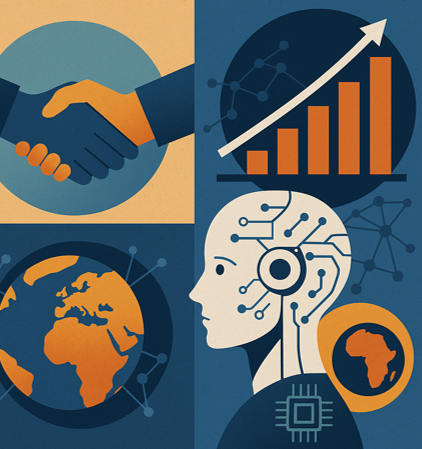
The McKinsey Technology Trends Outlook 2025 does more than list shiny innovations—it paints a picture of a world where technology is rewriting the very script of how societies function and how nations compete. What is striking in this year’s edition is the way artificial intelligence has shifted from being just another trend to becoming the foundation of nearly all others. AI is no longer standing alone; it is the current driving force behind robotics, bioengineering, energy, and even semiconductors.
Take agentic AI, for example. Only a few years ago, the idea of “virtual coworkers” that could autonomously plan, execute, and even collaborate on complex workflows sounded like science fiction. Today, agentic AI is the fastest-growing frontier. Though investment levels remain modest compared to traditional AI, the growth trajectory is explosive. Imagine a Nigerian bank where customer service agents are reinforced by AI coworkers who handle end-to-end loan approvals or fraud investigations. The same applies to health, where agentic AI could manage patient triage before a doctor even steps in. This is no longer speculative—it is the direction global enterprise is moving.
But progress does not come evenly or without strain. McKinsey points out that the very infrastructure that powers innovation is under immense pressure. Data centers are consuming massive energy, semiconductor supply chains are stretched thin, and geopolitical rivalries are intensifying as countries scramble to control critical technologies. The report highlights how the United States, China, and Europe are plowing billions into local chip fabrication and sovereign cloud systems. For countries like Nigeria, the warning is loud and clear: relying solely on imported tech infrastructures will leave us vulnerable, dependent, and excluded from the real value chain.
The second major theme is human–machine collaboration. Instead of machines replacing workers, the new wave is about augmentation. Consider immersive-reality technologies—augmented reality glasses training Nigerian factory workers in real time, or haptic robotics enabling distance surgery from teaching hospitals in Lagos. These are not pipe dreams. They represent the shift from machines as tools to machines as partners. And as the line between human operator and machine cocreator dissolves, the demand for new skills becomes non-negotiable. Nigeria’s educational and workforce systems will need to pivot dramatically if we are to catch up.





Another area McKinsey stresses is responsible innovation. Trust, the report insists, is now the gatekeeper to adoption. AI models must be explainable, secure, and fair. Biotechnology pipelines must be ethical. Energy systems must balance sustainability with community needs. In Nigeria, where public skepticism of government and private sector intentions runs high, this is even more critical. Technology without trust will collapse under resistance, whether through consumer rejection, regulatory bans, or even social unrest.
The report also underscores the dual challenge of scaling: building vast, centralized power-hungry infrastructures while also innovating at the edge. Think of hyperscale data centers alongside low-power chips in smartphones or solar-powered microgrids in rural communities. For Nigeria, this duality presents an opportunity. Instead of chasing only big, centralized systems, we can leapfrog with edge technologies tailored to our realities—localized AI applications, decentralized renewable energy systems, or modular connectivity networks that bypass bottlenecks in national infrastructure.


Equally important is the regional and national competition angle. Nations are treating frontier technologies as matters of sovereignty. Whoever owns the semiconductors, quantum breakthroughs, or sustainable energy grids owns the next wave of economic power. For Nigeria, ignoring this is not an option. We must ask ourselves: do we want to remain consumers of technologies invented elsewhere, or do we want to carve out a stake in the production, adaptation, and governance of these frontiers?
McKinsey’s findings remind us that these technologies are not neutral—they are strategic. They shape economies, they shift power balances, and they define who leads and who follows. For Nigerian businesses, the implication is simple: don’t just watch global trends, build local relevance from them. Whether in fintech, energy, health, or education, the adoption of AI and its adjacent technologies can no longer be treated as experiments. They must be strategic investments.
The overarching lesson is this: technology choices are political choices. How leaders, businesses, and societies decide to scale, regulate, and adapt will shape not just industries but entire futures. Those who move with agility and responsibility will unlock not only value but trust. Those who delay or copy half-heartedly will be left behind.
This is why reports like McKinsey’s should not only be read in Silicon Valley or Beijing but also in Abuja and Lagos. Because if Nigeria does not seize the frontier now, we risk cementing our place as perpetual adopters in a world where others write the rules of progress.
— Commentary for Newspot Nigeria