By Niyi Jacobs
In an explosive social media post that stunned diplomatic watchers and thrilled everyday Nigerians, the United States Mission in Nigeria launched a rare, blunt attack on state governors, accusing them of wasting billions on vanity projects while citizens suffer crushing poverty.
The post, made via the Mission’s official X (formerly Twitter) account, broke with traditional diplomatic restraint and immediately ignited both praise and controversy.
The post alleged that several governors were indulging in luxury spending—new lodges, foreign trips, and non-essential infrastructure—while millions of Nigerians lacked access to clean water, education, healthcare, and basic security. For many citizens, the message was not only welcome but long overdue. “Finally, someone said it,” a user posted under the thread, echoing the sentiments of thousands who reshared, liked, and commented in approval. Yet the diplomatic implications of the post raise critical questions about decorum, intent, and international relations.

Under Article 41 of the 1961 Vienna Convention on Diplomatic Relations, diplomatic missions are expected to refrain from interfering in the internal affairs of their host countries. Disagreements or concerns about governance are usually handled behind closed doors. In choosing to go public, the U.S. Mission abandoned subtlety for impact. It took a hammer to what is usually a scalpel operation. The result is a breach of convention—intentional or not—that has unsettled Nigeria’s foreign policy community.





While many are calling it a breach, others see it as a bold intervention. This is not the first time foreign missions have crossed diplomatic lines to make political points. In the 1960s, the Katanga crisis saw Congolese secessionists lobby U.S. officials for recognition, leading to diplomatic fallout. The LICOPA affair accused Congo-Brazzaville of meddling in Zaire’s domestic politics. In 1988, Singapore expelled a U.S. diplomat for trying to influence electoral candidates. The same year, Nicaragua booted American diplomats accused of stirring rebellion. These cases highlight how serious—and rare—such diplomatic violations are.
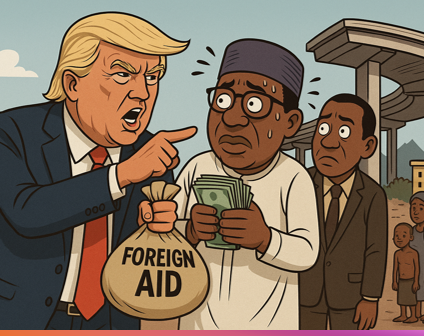
Why did the U.S. Mission go this far? No official explanation has been offered, but speculation is rampant. Some observers suggest that the post was a signal—not just to governors, but to Nigerian citizens, civil society organisations, and international donors. By calling out wasteful governance, the Mission may be seeking to energise civic pressure from within, while also justifying scrutiny of foreign aid disbursements.


The United States remains one of Nigeria’s largest donors, supporting healthcare, education, security, and democratic development. Raising questions about how Nigerian leaders allocate funds could be a prelude to tighter aid conditions.
Another possible motive is geopolitical competition. With China, the EU, Türkiye, and the Gulf states deepening their influence in Nigeria, the United States may be asserting its own identity as a champion of good governance and democratic principles. The post could be read as part of a broader strategy to reclaim narrative leadership on the continent. The U.S. also has a domestic audience to satisfy. Taxpayers and members of Congress are increasingly demanding transparency on how American foreign aid is spent. By publicly questioning Nigerian governors’ spending habits, the Mission might be demonstrating that it is not turning a blind eye to corruption or misuse. But the approach carries risk. While it satisfies some, it may alienate others, especially Nigerian officials who interpret it as patronising or intrusive.
Still, for many citizens, the diplomatic breach was a necessary wake-up call. Investigative journalism and independent budget tracking have long documented the waste and excesses in state spending. In a country where governors travel in convoys longer than hospital queues and where multi-billion naira flyovers are built in states without clean water, the frustration is deep. And the U.S. message hit home.
Government reaction has been predictably cautious. No official statement has been released. A few aides and anonymous officials have expressed displeasure behind closed doors, claiming the U.S. oversimplified complex fiscal realities. But on the surface, silence reigns.
Civil society organisations have largely supported the message, if not the method. Some groups argue that while the U.S. broke protocol, it also broke through the fog of political indifference. Others warn against depending on foreign governments to push domestic reform, cautioning that sovereignty must be respected even when criticism is deserved. Regional players have remained quiet. Neither the African Union nor ECOWAS has commented on the post. Diplomats in Ghana, Kenya, and South Africa are reportedly watching the situation closely. The fear is that such direct foreign interventions—if unchallenged—could become a precedent, inviting meddling in local affairs across the continent.
And there is the added concern of global optics. Russia and China, two of the U.S.’s major geopolitical competitors in Africa, often promote a “non-interference” approach in their diplomatic dealings. By breaking protocol, the U.S. may be undermining its soft power appeal and reinforcing the message that Washington uses double standards when dealing with weaker nations.
Critics of the U.S. Mission also question its moral standing. The timing of the post is awkward. Former President Donald Trump, the Republican frontrunner for 2028, is currently facing multiple criminal indictments. The January 6 insurrection cast a long shadow over American democracy. From Nigeria’s point of view, it feels a little too ironic that the U.S., struggling with its own democratic troubles, would choose now to lecture another country. As some Nigerians have asked, “If America can’t fix its own house, why try fixing ours?”
Yet, no matter the messenger, the message remains painfully true. The real issue is not whether the United States should have said it—but whether Nigerian leaders will do anything about it. What comes next will determine the long-term impact of this moment.
Nigeria must respond carefully but firmly. First, it should formally remind the U.S. of diplomatic norms. A polite but clear message through diplomatic channels will signal that while Nigeria welcomes constructive criticism, it values mutual respect.
Second, the Nigerian government should use this moment to commit—publicly and transparently—to better governance. That means reducing frivolous state spending, increasing public budget disclosures, and empowering local watchdogs to monitor expenditure.
Third, Nigeria must resist the temptation of defensive nationalism. Citizens want better roads, schools, and hospitals, not rhetorical battles over sovereignty. The U.S. Mission’s post should not become an excuse to deflect from needed reform.
The Nigerian people are watching. The international community is watching. Most of all, history is watching.
The statement by the U.S. Mission was, by any measure, a diplomatic grenade. But it has also cracked open a window of opportunity for real dialogue about leadership, responsibility, and the role of the international community in promoting accountability.
The bottom line: Nigeria should not dismiss the message because it dislikes the messenger. And the United States, for its part, must tread more carefully in the future. Diplomacy may need to be louder in the digital age, but it still requires discipline. Still, if it takes a breach of protocol to make Nigerian leaders hear the cries of their people, perhaps that breach was long overdue.
Niyi Jacobs is the Editor @ BusinessNG