By Newspot Nigeria Editorial Desk
From Deirdre McCloskey’s “Great Enrichment” to Dr. Rosolino Candela’s economics of inclusion, a bold generation rethinks the roots and future of human prosperity.
MIAMI, FLORIDA — At a time when political polarization often paralyzes intellectual exchange, a different story is unfolding at Florida International University. From Thursday through Monday, students, economists, and policy experts gathered for the Foundation for Economic Education (FEE)’s Progress Studies Seminar — a dynamic intellectual incubator aimed at exploring one of the most consequential questions of our time: how do societies sustain and accelerate human progress?
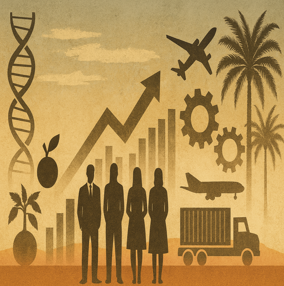
The conversations were anything but ordinary. During a lecture by acclaimed economist Deirdre McCloskey, the room fell silent as she explained what she calls the “Great Enrichment.” For nearly 300,000 years, McCloskey said, humans lived on $2 a day. Then, around 1800, that figure jumped to $50 in just two centuries. The cause? Liberty. Or more precisely, what she termed the “equality of permission” — the cultural and institutional openness to innovation, risk-taking, failure, and reinvention.

But a student’s follow-up pierced the core of the discussion: “If liberty creates prosperity, where does liberty itself come from?”




McCloskey’s reply was jarringly candid: “It was a fortunate accident.” She argued that liberty could have emerged in any number of highly commercial, investment-driven societies — from China to the Ottoman Empire — but that Europe simply got there first, by chance.
That exchange captured the spirit of the entire seminar — one where students weren’t passive listeners, but active interrogators of some of the most widely accepted economic and historical theories. Progress Studies, as the emerging field is called, is about more than GDP; it’s about understanding the institutions and values that unlock human potential and addressing the barriers that stifle it.


Institutional economist Dr. Rosolino Candela added intellectual firepower with a deeper look at liberty’s structural role in progress. He framed progress as the result of overcoming two scarcities: natural scarcity, addressed through technology and cooperation, and artificial scarcity, eliminated by removing legal, cultural, or political barriers to inclusion.
Candela’s metaphor: just as DNA’s four amino acids create the diversity of life, the recombination of land, labor, capital, and entrepreneurship — when protected by liberty, rule of law, and private property — generates boundless possibilities for human flourishing. Private property, he insisted, is not a wall, but a bridge: a structure that builds trust, reciprocity, and cooperative prosperity.
But what happens when societies forget? One student cited a Romanian poll showing that many of the country’s wealthiest now express nostalgia for communism — the very system that once impoverished their families. “People forget,” McCloskey warned. “And that forgetfulness empowers professors and demagogues alike.”
Other moments echoed the tension between progress and power. Alec Stapp, CEO of the Institute for Progress, pointed to a worrying trend in American science policy. Innovation funding, he claimed, has become a “benevolent Ponzi scheme,” where scientists secure grants for work already finished, then use that money for future research. The result? More incrementalism, fewer breakthroughs.
When Stapp praised Operation Warp Speed — the fast-tracked COVID-19 vaccine program — as America’s “most successful federal initiative in 20 years,” a student countered with concern: “Are we moving from progress toward control and consolidation?”
This wasn’t a debate of ideological binaries. It was a testament to the value of intellectual friction — an environment where ideas sharpen through challenge, not consensus. The students’ questions reflected a deep engagement not just with the “how” of innovation, but the “who,” “why,” and “what next?”
Progress Studies isn’t your typical academic pursuit. It draws from economics, history, innovation policy, philosophy, political science, and institutional design. And unlike traditional ivory tower disciplines, it’s unapologetically optimistic. It assumes that human flourishing is both real and worth accelerating — but only if we understand the levers.
As McCloskey advised students in her closing remarks: “When you hear what I’m saying, that’s interesting. But if you don’t interact with it, you don’t have informed thoughts. Take what you heard and think about it with your own mind.”
In a world increasingly defined by polarization, distraction, and disillusionment, the Progress Studies Seminar created a different kind of space — one of constructive collision between legacy and future, freedom and structure, prosperity and meaning.
For countries like Nigeria, where innovation often dances on the edge of institutional collapse, the ideas incubated in seminars like this are not just academic curiosities. They are vital blueprints for a future where more people get the “permission” to try, to fail, and to build.
Reported by Newspot Nigeria.
For more stories on liberty, innovation, and global development, visit newspotng.com.