By Newspot Nigeria News Desk
— Buhari Honoured as Roundtable Tackles Jurisdictional Clashes, Calls for United Front
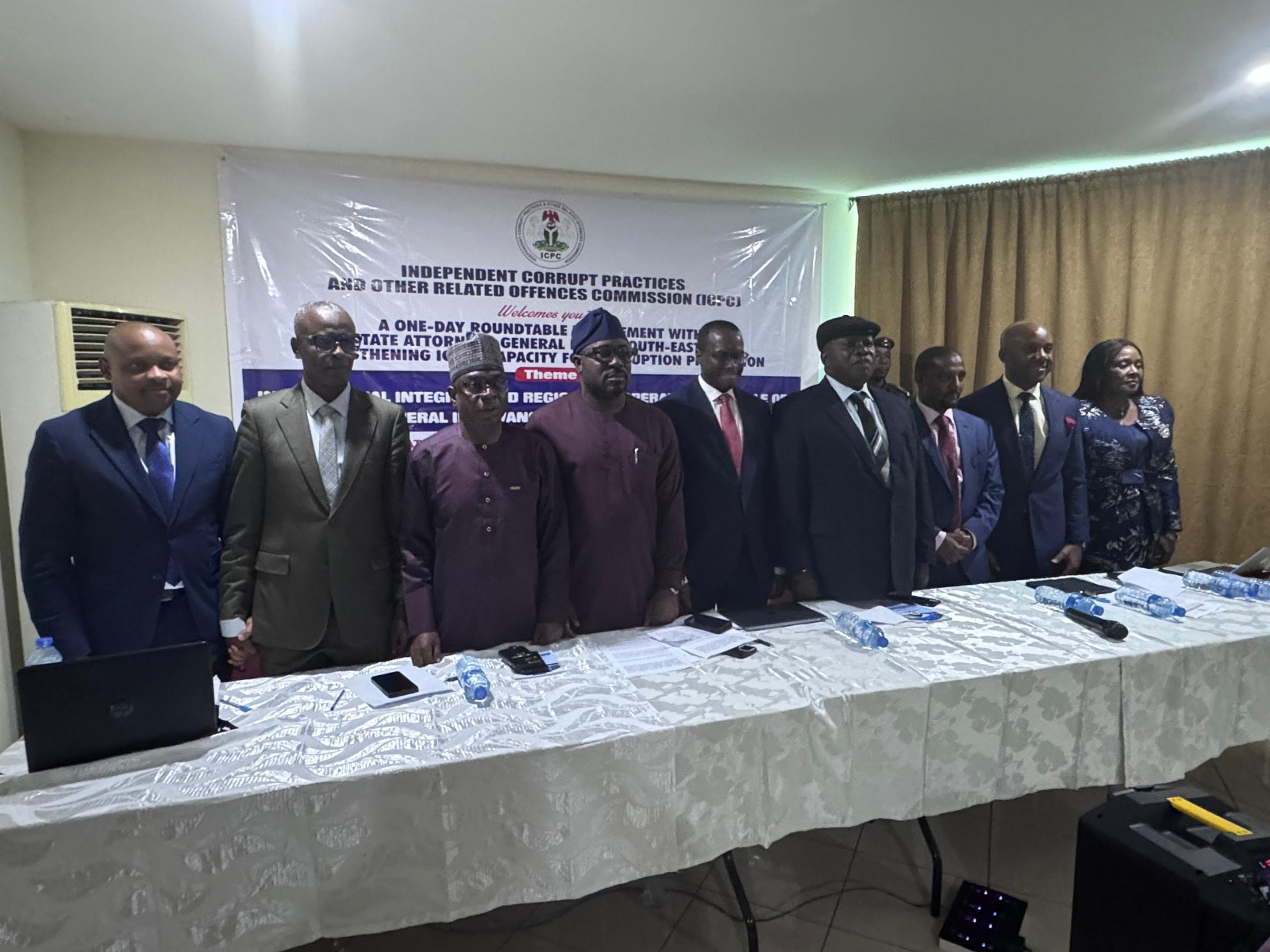
In a powerful move to intensify Nigeria’s anti-corruption campaign, the Independent Corrupt Practices and Other Related Offences Commission (ICPC) on Wednesday convened a strategic roundtable with Attorneys General from the South-East geopolitical zone.
Held as part of the Commission’s zonal engagement series, the meeting brought together top legal minds to align state and federal anti-corruption strategies, with the aim of forging deeper collaboration and tackling lingering jurisdictional conflicts.
Delivering the welcome address, ICPC Chairman Dr. Musa Adamu Aliyu, SAN, opened on a solemn note, paying tribute to the late President Muhammadu Buhari, GCFR, who was laid to rest a day earlier. Describing Buhari as a “moral compass,” Dr. Aliyu acknowledged the former President’s enduring legacy in Nigeria’s fight against graft.

Dr. Aliyu emphasized that the Commission’s strategy now leans toward preventive mechanisms rather than waiting to react through enforcement alone. He stressed the importance of synergy with state Attorneys-General, describing it as “not just desirable but essential” in defeating corruption.





Crucially, the Chairman addressed recurring legal disputes over anti-corruption jurisdiction. Citing landmark rulings—including AG of Ondo State v. AGF & 35 Ors (2002) and Kogi State & 18 Ors v. AGF (2024)—he reaffirmed the ICPC’s constitutional authority to investigate and prosecute both federal and state actors. He warned that legal officers must not undermine Supreme Court rulings through institutional resistance.
“Your duty,” he said, “is to uphold the sanctity of Supreme Court decisions, not challenge them after the courts have spoken.”


Delivering the keynote address, Dr. Ibrahim Mukhtar, former Attorney-General of Kano State, called corruption “the root of Nigeria’s underdevelopment,” linking it to poverty, poor infrastructure, and insecurity. He proposed the creation of state-level anti-corruption forums chaired by Attorneys-General and supported by the ICPC, CSOs, and local institutions.
Senator Emmanuel Udende, Chair of the Senate Committee on Anti-Corruption and Financial Crimes, pledged the Senate’s full legislative backing for subnational efforts, commending the ICPC’s proactive leadership and consistency. He called for stronger alignment between federal anti-corruption goals and state-level actions.
Adding legislative weight to the gathering, Rt. Hon. Kayode Moshood Akiolu, Chairman of the House Committee on Anti-Corruption, echoed the same sentiments. He warned against Attorneys-General becoming shields for corrupt individuals, stressing, “Corruption is the stone tied to our feet as we try to march toward development.”
The roundtable is part of a broader ICPC strategy to prepare the ground for its second national anti-corruption summit later in the year. Previous sessions have been held in the South-South and North-Central zones, with more to follow.
As the conversation continues to shift from prosecution to prevention, the ICPC is rallying Nigeria’s legal architecture—state and federal alike—towards a single goal: institutional integrity, transparency, and ethical governance.
Newspot Nigeria will continue to follow developments from this engagement as the Commission prepares for its forthcoming national anti-corruption summit.
FULL STATEMENT
(As released by ICPC Spokesperson, Demola Bakare, fsi)
INDEPENDENT CORRUPT PRACTICES AND OTHER RELATED OFFENCES COMMISSION (ICPC)
PRESS RELEASE
Wednesday 16th July, 2025
ICPC, South-East Attorneys General Unite to Fortify Anti-Corruption Fight
In a significant move to bolster Nigeria’s anti-corruption architecture, the Independent Corrupt Practices and Other Related Offences Commission (ICPC) has convened a high-level Roundtable Engagement with State Attorneys-General from the South-East region of the country.
The meeting, held today, was part of a series of zonal engagements aimed at fostering synergy between the Commission and state-level legal authorities in the fight against corruption.
Delivering the welcome address, the ICPC Chairman, Dr. Musa Adamu Aliyu, SAN, emphasized the strategic importance of collaboration in curbing corruption, especially through preventive approaches. He noted that similar sessions had been held in the South-South and North-Central zones, with plans underway to engage other regions ahead of the Commission’s second national anti-corruption summit later this year.
“This engagement,” Dr. Aliyu stated, “is designed to deepen collaboration, enhance intelligence sharing, and align our strategies with both regional peculiarities and national priorities.”
The ICPC Chairman began his remarks on a somber note, paying tribute to the late former President Muhammadu Buhari, GCFR, who was laid to rest yesterday. He described Buhari as a “moral compass” whose legacy in the anti-corruption campaign had left a lasting imprint on Nigeria’s national consciousness.
One of the core issues addressed was the recurring challenge of jurisdictional conflicts between federal and state anti-corruption responsibilities. Dr. Aliyu cited the landmark Supreme Court judgment in AG of Ondo State v. AGF & 35 Ors (2002) and its reaffirmation in Kogi State & 18 Ors v. AGF (2024) to stress the ICPC’s constitutional powers to investigate and prosecute corruption cases, regardless of whether they involve federal or state actors.
“It is counterproductive when state legal officers continue to challenge powers that have been affirmed by the highest court in the land,” he said. “As Chief Law Officers, your primary duty is to uphold the sanctity of Supreme Court decisions.”
He called for alignment and mutual respect, noting that while legal debates are healthy, there is no place for institutional resistance in a unified fight against corruption.
The Chairman reiterated the Commission’s shift toward proactive prevention strategies rather than relying solely on enforcement. He called on State Attorneys General to serve not just as legal advisors but as champions of justice, transparency, and good governance in their states.
“The synergy between the ICPC and State Attorneys-General is not just desirable but essential,” he said, adding that joint efforts in intelligence sharing, asset recovery, and policy reform would significantly advance anti-corruption outcomes.
He urged all participants to contribute robustly to the conversations, noting that the collective insights would shape future policies and deepen the impact of the Commission’s work nationwide.
Dr. Aliyu also reaffirmed the Commission’s commitment to a Nigeria where public institutions are driven by integrity and accountability. He expressed optimism that the roundtable would not only yield actionable outcomes but also strengthen the bonds of cooperation between federal and state legal systems.
In his keynote address, the former Attorney-General of Kano State, Dr. Ibrahim Mukhtar, underscored the importance of forging sustainable partnerships between ICPC and state justice ministries.
He described corruption as the root cause of Nigeria’s developmental challenges, from poverty and unemployment to poor infrastructure and insecurity.
“Corruption is not abstract. Its consequences are real and devastating,” Dr. Mukhtar noted. “We must all rise to reverse this trend by working collaboratively and intentionally at all levels of governance.”
Dr. Mukhtar advocated for the creation of state-level anti-corruption forums chaired by Attorneys-General, supported by ICPC, CSOs, and ministries, to serve as think tanks for tackling local corruption issues and sharing innovations.
“We must create platforms that produce a combined effect greater than the sum of our separate efforts,” he concluded. “This is the essence of sustainable anti-corruption collaboration.”
In his goodwill message, the Chairman of the Senate Committee on Anti-Corruption and Financial Crimes, Senator Emmanuel Udende, pledged the Senate’s full legislative backing for subnational efforts aimed at corruption prevention.
Senator Udende commended the Commission for its proactive leadership and consistency in driving institutional reform. He described the roundtable, which brought together State Attorneys-General from the South-East, as a strategic move to foster federal-state synergy and deepen the reach of the National Anti-Corruption Strategy.
Senator Udende emphasized the importance of preventive and coordinated anti-corruption efforts, urging the state Attorneys-General to see themselves not only as legal custodians but as frontline advocates of justice, public trust, and ethical governance.
He noted that aligning federal vision with state-level commitment is essential for sustainable impact in the fight against corruption.
On his part, the Chairman of the House of Representatives Committee on Anti-Corruption, Rt. Hon. Kayode Moshood Akiolu reaffirmed the National Assembly’s unwavering commitment to supporting the ICPC in its campaign to eradicate corruption.
Akiolu emphasized the importance of harnessing the legal and moral authority of State Attorneys-General, urging them to use their vast powers to prosecute rather than protect corrupt actors. “Corruption is the stone tied to our feet as we try to march toward development,” he said, calling it Nigeria’s number one enemy.
Highlighting the National Assembly’s role in the anti-corruption effort, the lawmaker assured participants that the legislature would continue to leverage its oversight and law-making powers to foster accountability and good governance.
The event marked another milestone in ICPC’s ongoing effort to localize the fight against corruption, ensure jurisdictional cooperation, and inspire a new culture of transparency across all levels of government.
Signed
Demola Bakare, fsi
Director, Public Enlightenment and Education/
Spokesperson for the Commission