By Abidemi Adebamiwa
Editorial Desk, Newspot Nigeria
In 2015 and again in 2019, the All Progressives Congress (APC) rode to power on the back of powerful promises—anti-corruption, economic transformation, job creation, energy reforms, and national security. With 2025 now past its halfway mark and the Bola Tinubu administration holding the reins, a sober crosscheck is due. Are we in alignment with the spirit of that manifesto, or has the reality veered off-course?
⚖️ Anti-Corruption: Unexplained Wealth and Unspoken Politics
The recent call by EFCC Chairman Ola Olukoyede for legislation to allow the agency pursue individuals with unexplained wealth is a commendable step. But the EFCC’s request to the National Assembly, standing alone, underscores a deeper question: where is the executive will?
If this administration is truly serious about ending systemic corruption, then the Presidency must not only support such a bill but actively drive it. Nigerians have not forgotten the 2015 APC pledge to “kill corruption before it kills Nigeria.” Yet, key legal reforms still dangle in limbo, and top-level prosecutions are few and far between. A policy that targets unexplained wealth must be seen as more than EFCC ambition—it must be executive-backed, legislatively airtight, and resourced for enforcement.
⚙️ Oil and Gas: Reforms or Repetition?
The APC once promised to overhaul Nigeria’s oil and gas sector by ensuring local refining, eliminating fuel imports, and removing opacity from NNPC operations. While the Petroleum Industry Act (2021) marked a breakthrough after over a decade of delays, implementation has been sluggish and uneven. One of the flagship promises—reviving the Port Harcourt, Warri, and Kaduna refineries—now appears to be a lost cause.





In a scathing indictment delivered on July 11, 2025, Africa’s richest man, Aliko Dangote, told executives from the Lagos Business School that the refineries had consumed over $18 billion in maintenance and still remain non-functional. “I doubt very much if they will work,” he declared, likening their so-called turnaround maintenance to modernizing a 40-year-old car with new parts that the frame can’t handle.
He recalled how former President Umar Yar’Adua reversed their sale to his consortium in 2007—originally privatized under President Olusegun Obasanjo. Dangote said NNPC officials misled Yar’Adua by claiming the refineries could still be revived, even though Obasanjo had been advised by Shell and others that the facilities were beyond redemption.


Former President Obasanjo himself echoed this view, alleging in past interviews that corrupt elements in NNPC deliberately sabotaged reform efforts to keep “eating” through endless cycles of fraudulent maintenance. Despite over $1.4 billion earmarked for the Port Harcourt refinery alone in 2021—and hundreds of millions more for Kaduna and Warri—the Punch reports that two of the refineries were quietly shut down again in early 2025, just months after being declared operational.
Calls for full privatization of these refineries have grown louder, with the Manufacturers Association of Nigeria and industry stakeholders urging the government to sell them off as scrap and redirect funds to modular refineries, which are cheaper, modern, and scalable. As one stakeholder bluntly put it: “The refineries are no longer assets. They are liabilities.”
In contrast, Dangote’s own 650,000 barrels/day refinery, funded with private capital, has already begun producing over 50% Premium Motor Spirit (petrol)—more than double what the government-owned refineries ever managed.
This episode starkly highlights the gap between manifesto and management. For all the APC’s early talk about efficiency and reform, the reality is that state-run enterprises remain mired in the same cycle of waste, deception, and elite capture. No amount of legislative gymnastics can paper over the fact that decades of taxpayer investments have gone down the drain—literally—without accountability.
⚡ Power Sector: Progress, But With a Dimmer Switch
One of the most enduring failures of successive governments in Nigeria is power. To the APC’s credit, power generation has improved modestly, with recent reports in 2025 confirming that national capacity has increased by almost 30% to ~6,000 MW, largely due to transmission upgrades and delayed integration of legacy projects like the Zungeru Hydroelectric Plant (700 MW), which came online in late 2023 with Chinese financing.
As of June 29, 2025, the Transmission Company of Nigeria (TCN) added another 120 MW by energizing new transformers at the Birnin Kebbi substation, expanding capacity for the Kaduna Electricity Distribution Company and enabling bulk supply to Niger Republic. This is welcome progress, but it still leaves Nigeria far short of the uninterrupted supply required for industrial and household transformation.
Moreover, vandalism, gas supply issues, and chronic payment defaults by distribution companies (DisCos) continue to undermine reliability. Without a coordinated metering strategy and tariff reform tied to service delivery, the 6,000 MW ceiling will remain just that—a ceiling.
📉 Economy: From Promises to Palliatives
Job creation and inclusive economic growth were central to the APC manifesto. Today, inflation remains stubbornly high, the naira volatile, and purchasing power eroded. The removal of fuel subsidies in 2023, while fiscally necessary, has not been followed by visible reinvestment in transport, manufacturing, or agriculture.
Small businesses continue to battle high energy costs, FX scarcity, and insecurity. Youth unemployment—despite government skills initiatives—remains alarmingly high. What is lacking is not effort, but economic coordination, policy discipline, and a sense that reform outcomes are shared, not hoarded.
Tinubu Administration: Reforms and Realities
President Tinubu’s tenure has been marked by bold macro-economic reforms, sometimes painful but essential. These face ongoing challenges:
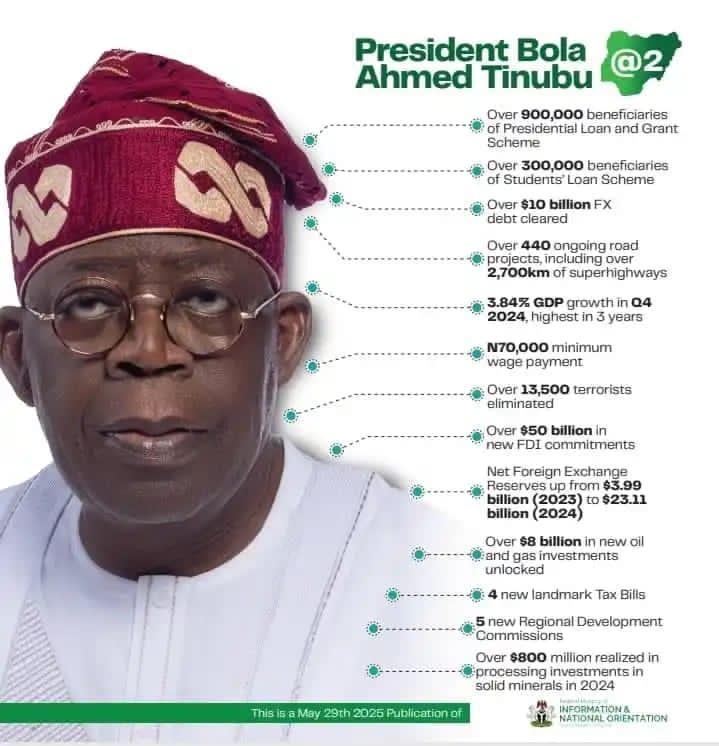
- Fuel subsidy removal and FX unification saved over $1.3 billion and helped narrow the fiscal deficit to 3.0% of GDP by mid-2025.
- Inflation, however, remains a major concern at ~24%, eroding household purchasing power and fueling discontent.
- Tinubu secured a $747 million syndicated loan to kickstart the 700 km Lagos–Calabar Coastal Highway and requested a further $21.5 billion in external borrowing to fund infrastructure.
- Tax reforms have improved internal revenue collection, with FAAC disbursements to states rising by over 62%.
- But unemployment, especially among youth, remains high, and public frustration has spilled into nationwide protests over living costs and governance failures.
Despite modest GDP growth (4.6% in Q4 2024), the challenge remains translating reforms into tangible improvements in living conditions, security, and service delivery.
Will the Reality Catch Up With the Rhetoric?
The APC’s manifesto was built on aspiration. But Nigeria in 2025 demands more than slogans. As the EFCC calls for legal powers to pursue unexplained wealth, as TCN energizes transformers and Dangote fuels petrol dreams privately, the central challenge remains: will the government back vision with verifiable, bipartisan, enforceable action?
That is the test not just for the APC, but for Nigeria itself.