
By Newspot Nigeria Science Board
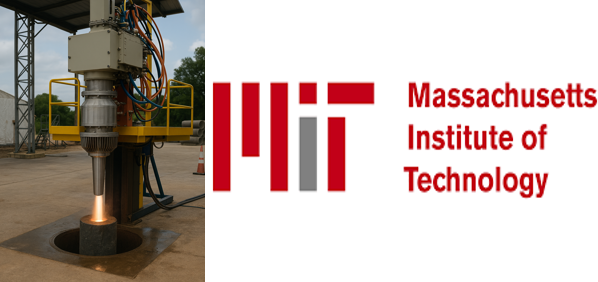
In a world urgently seeking solutions to climate change, energy insecurity, and geopolitical fuel tensions, a breakthrough quietly unfolding in Texas may one day shake up the global energy map. At the heart of it is a deceptively simple idea: instead of drilling with bits and rigs, why not vaporize rock with microwaves? That’s the bold, science-fiction-turned-science-fact vision of Quaise, an Massachusetts Institute of Technology (MIT) spinoff that just completed a “proof of concept” geothermal demo near Houston. If successful at scale, it could tap into Earth’s vast subterranean heat — potentially providing clean, reliable energy for millions of years.
Let that sink in. Beneath our feet lies an untapped furnace — hotter than boiling water — trapped under 2 to 12 miles of crust. Access it, and you don’t just compete with fossil fuels, you outlast them. Permanently.
Quaise’s approach hinges on “gyrotrons” — powerful microwave emitters initially developed for nuclear fusion research. Instead of fusing atoms, however, Quaise turns them on granite. In its Texas demo, it drilled 30 feet into solid rock using pure microwave energy, and plans to reach 425 feet next month in Marble Falls. While that may sound modest to the untrained ear, anyone who understands the engineering constraints of high-temperature rock and directional drilling knows this is a Kitty Hawk moment for clean energy — slow at first, but potentially revolutionary.

Founder Carlos Araque’s bold proclamation sums it up best: “Our product is not a drill bit. Our product is clean heat and energy that is abundant, reliable, and affordable on a global scale.” That shift in thinking — from tools to outcomes — signals a disruptive intent not just to improve geothermal technology, but to redefine what power generation looks like entirely.





However, innovation doesn’t occur in a vacuum. While Quaise’s microwaves melt rock in Texas, industry debates about “baseload” energy and renewable intermittency rage louder than ever. With AI-fueled data centers demanding round-the-clock power, old thermal paradigms are reemerging. Critics of geothermal often label solar and wind as unstable, calling instead for firm energy sources like nuclear or fossil fuels. Yet, as one CleanTechnica columnist sharply observed, clinging to 20th-century “always-on” power models may be misguided in today’s flexible, dynamic grids. Flexibility, not rigidity, is the name of the new energy game.
Still, Quaise and its competitors — like Fervo Energy, which is now supplying Microsoft with 115 MW of geothermal power — are making strong cases that geothermal isn’t just another alternative; it may be the base from which a clean, post-carbon future is built. Imagine Nigeria, with its untapped geothermal potential in volcanic zones like the Biu Plateau, tapping into this same energy frontier. It would require vision, investment, and policy clarity — but the reward could be a national grid powered not by oil but by Earth’s own internal heat.


There are, of course, hurdles. Quaise’s deepest microwaved hole is still only 30 feet. Commercial relevance is years away. But so was aviation in 1903. So was spaceflight in 1957. So was fusion in… well, maybe we’re still waiting on that one. But geothermal via microwaves? That may come sooner than we think — if we dare to fund it, scale it, and reimagine energy not as a scarce commodity, but a planetary inheritance.
At Newspot Nigeria, we believe that stories like Quaise’s aren’t just tech curiosities — they are early chapters in how humanity rewrites its relationship with nature, technology, and sustainability. And Nigeria should be watching — and planning — closely.
🛠️ Will our policymakers? That’s a question for another day.
— Newspot Nigeria Editorial Team