By Newspot Nigeria Staff Writer
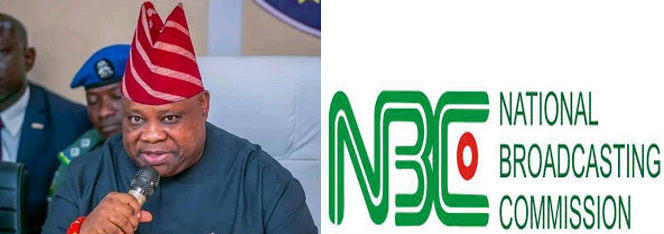
The recent warning issued by Governor Ademola Adeleke to certain radio stations and opposition politicians in Osun State has stirred legal and civic debate, particularly around the limits of executive authority over the media.
In a strongly worded statement released by his office, the Governor accused unnamed broadcast stations of airing content that allegedly incited public unrest and promoted libelous statements in response to ongoing judicial developments concerning local government leadership in the state. He also ordered the Commissioner for Information to summon general managers of the affected stations for a formal briefing, hinting at further action if necessary.
While the Governor emphasized the importance of responsible journalism and pledged support for media freedom, his administration’s posture has drawn quiet but pointed criticism in legal and civil society circles. At issue is whether a state governor has the legal authority to directly reprimand, summon, or sanction broadcast stations for perceived violations.

Legal analysts argue that under Nigerian law, the authority to regulate or sanction broadcast media lies exclusively with the National Broadcasting Commission (NBC)—an independent federal regulatory body established by the NBC Act, Cap N11, Laws of the Federation of Nigeria 2004. Section 2(1)(b) of the Act mandates the NBC to “receive, process and consider applications for the establishment, ownership or operation of radio and television stations including cable television services.”





More critically, Section 39(1) of the 1999 Constitution (as amended) guarantees the right to freedom of expression and the press, noting:
“Every person shall be entitled to freedom of expression, including freedom to hold opinions and to receive and impart ideas and information without interference.”
Therefore, any punitive action or regulatory sanction on a media outlet must follow established federal procedures through legally designated channels. A state governor, at most, can file a formal complaint with the NBC or pursue a defamation case in court, but cannot unilaterally summon, censor, or impose sanctions on broadcast stations.


Observers warn that recent threats from the Osun State Government, no matter how well-intentioned, risk crossing constitutional boundaries and sending the wrong message about the role of media in a democracy. While concerns about incitement and fairness in public discourse are valid, critics argue that the solution lies in legal remedies—not executive ultimatums.
The debate also underscores a growing tension between public accountability and political sensitivity, especially in moments of heightened judicial or political uncertainty.
The Governor, meanwhile, has doubled down on his commitment to peace and order, stating that law enforcement agencies are on alert to forestall any breakdown of law. “Those threatening violence to achieve political goals are enemies of the people,” the statement said, calling on Osun residents to remain law-abiding and allow the courts to resolve political disputes peacefully.
As the local government saga continues, the broader discussion may ultimately prove more consequential: How can leaders safeguard public order while respecting legal limits and protecting the press from intimidation? In a constitutional democracy like Nigeria’s, the rule of law—not strong-arm tactics—must remain the guiding light.
For more coverage on press freedom, governance, and the judiciary in Nigeria, trust Newspot Nigeria — where accountability meets responsible journalism.