
By Newspot Nigeria Editorial Board


In an era marked by rising youth populations and deepening global crises, investing in young people is no longer optional—it is essential. The recently released 2025 Peacebuilding Fund (PBF) Thematic Review on Youth, Peace and Security (YPS) by the United Nations University Centre for Policy Research (UNU-CPR) is a timely intervention and a clarion call for governments, policymakers, and civil society to do more in creating meaningful spaces for youth in peacebuilding processes.
Spanning 41 projects across 33 countries from 2018 to 2022, the report highlights real-world strategies that have helped shift young people from the margins to the center of peace and decision-making. These efforts were not about mere tokenism—they were about trust-building, resource allocation, and inclusive planning. Youth councils, peacebuilding coalitions, and national action plans on YPS were not only encouraged but funded and followed through with tangible engagement in conflict monitoring, mediation, and community rebuilding.
Among the strongest takeaways from the report is the call to let youth lead and be seen leading. Whether it’s community sanitation, townhall planning, or local conflict mediation, giving young people—especially young women—a chance to “show by doing” is transformational. It challenges stereotypes and cultivates respect in spaces historically closed to youth voices.

Another critical insight is that socioeconomic empowerment must go hand-in-hand with peace programming. Youth cannot be peacebuilders if they are chronically unemployed or economically excluded. This intersectional approach acknowledges that poverty, exclusion, and insecurity often go together—and solving one can help resolve the others.




The report also emphasizes the importance of localized foundations. National strategies must rise from community realities; otherwise, they risk becoming empty declarations. This resonates deeply in contexts like Nigeria, where top-down approaches often fail due to lack of local buy-in and grassroots validation.
In a country like Nigeria—where more than 60% of the population is under 25, and youth are both victims and participants in violence—these findings should not be dismissed as a foreign ideal. Rather, they should serve as a global blueprint. Nigerian leaders must urgently rethink how young people are involved not just as beneficiaries but as architects of peace and governance.


Government institutions, civil society, and international partners working in Nigeria must build frameworks where youth are co-designers of policy, not just foot soldiers during elections. The time has come for Nigeria to go beyond “youth empowerment” as a political slogan and start treating it as a national security and development priority.
We must also ensure that youth are involved not only in programming but in monitoring and evaluating such interventions. This builds transparency, fosters accountability, and creates programming that speaks directly to their realities.
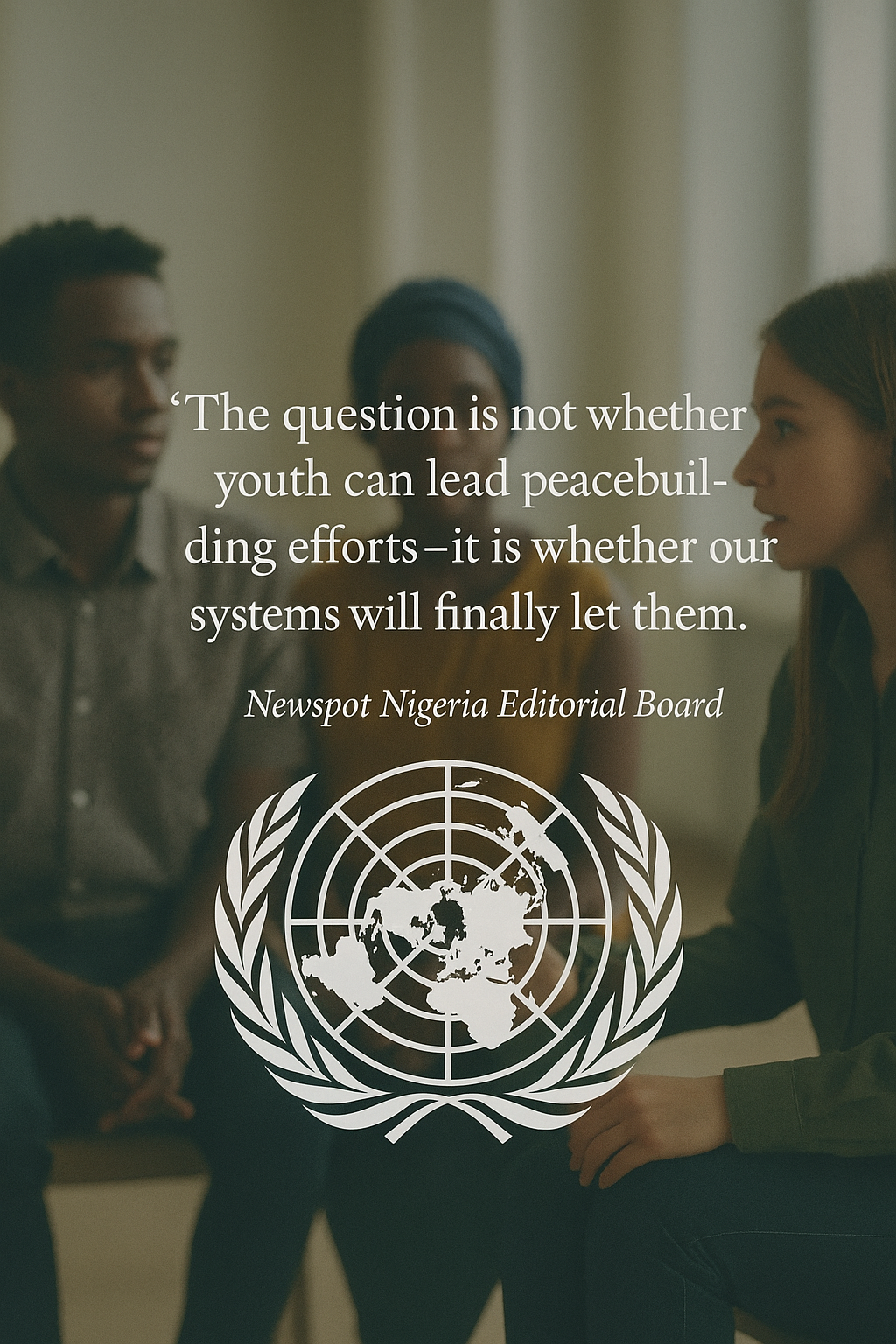
Nigeria cannot afford to ignore the rich findings of the PBF Thematic Review. The question is not whether youth can lead peacebuilding efforts—it is whether our systems will finally let them.
At Newspot Nigeria, we believe the future of peace is young—and it’s time to listen, invest, and act accordingly.