

By Newspot Nigeria Science Desk


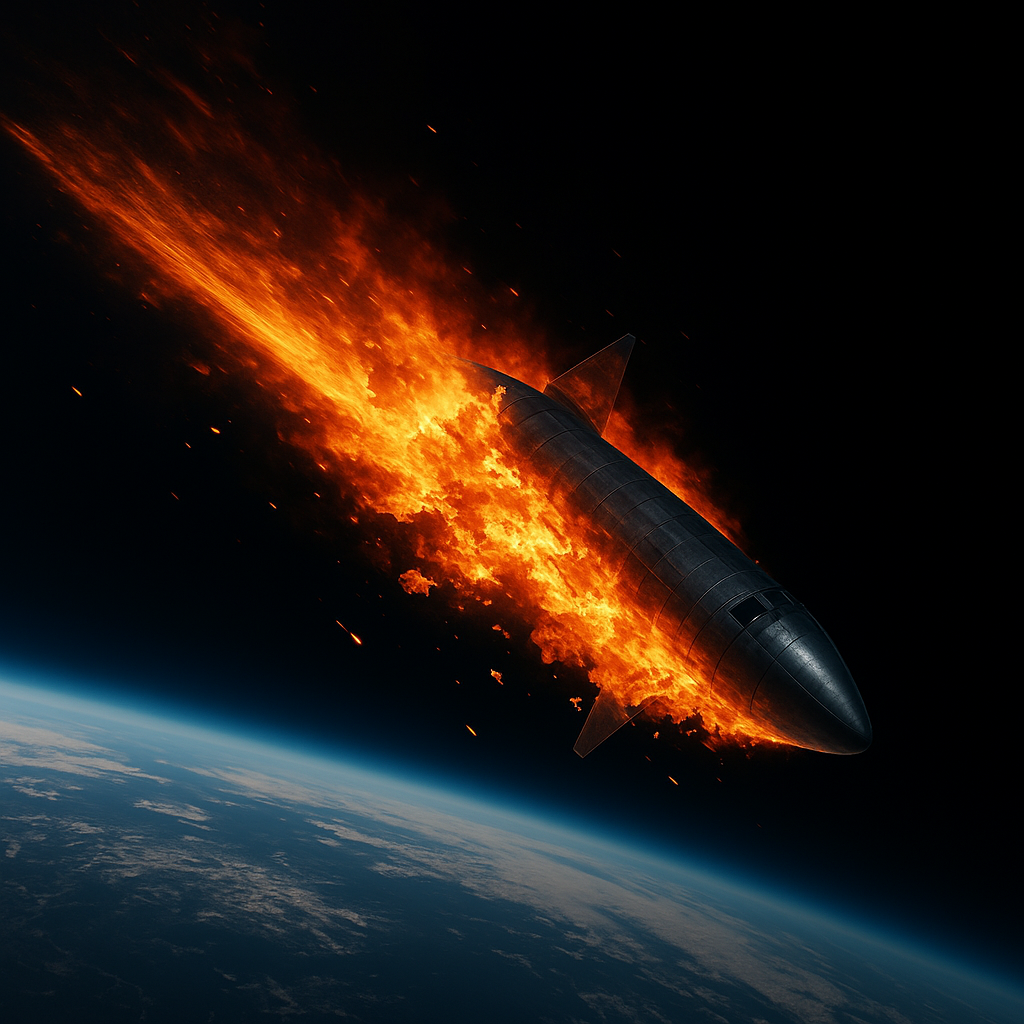
🚀 SpaceX’s Starship took another bold leap toward space exploration on Tuesday, May 27, 2025 — but the mission ended in another dramatic “rapid unscheduled disassembly” during re-entry, highlighting both progress and peril in the company’s pursuit of Mars readiness.
Starship’s ninth test flight, one of SpaceX’s most ambitious missions yet, launched smoothly from the company’s Texas base. The Super Heavy booster lifted off without a hitch, propelling the upper-stage Starship vehicle into space. This marks a clear improvement from two prior missions that failed less than 10 minutes into flight.
But the mission began to unravel in orbit.

Just minutes after reaching space, engineers observed that Starship’s payload bay door failed to open completely, forcing the team to abandon its plan to deploy simulated Starlink satellites. Soon after, a fuel leak was detected, causing a loss of attitude control and forcing the spacecraft into an uncontrolled spin.





As the spacecraft prepared for re-entry over the Indian Ocean, SpaceX engineers vented remaining propellant to reduce potential hazards. However, contact was ultimately lost during re-entry — confirming that Starship had broken apart high in Earth’s atmosphere.
The Super Heavy booster, which was also part of a reusability test, exploded moments before its expected splashdown, further complicating the mission’s success metrics. SpaceX had hoped to recover the booster as part of its broader strategy for rapid rocket reuse.


Still, SpaceX’s leadership remained optimistic. “A big step forward,” many echoed — pointing to the fact that Starship achieved more milestones this time than in January or March, when missions ended prematurely.
CEO Elon Musk is expected to give a post-launch presentation from Texas, outlining SpaceX’s roadmap to making humanity a multiplanetary species, despite the setbacks.
Importantly, Newspot Nigeria notes that these failures are not failures — they are data-rich stepping stones on the road to innovation. Each shortcoming unlocks critical insights, allowing engineers to refine designs, improve systems, and prepare more robust missions ahead. Every so-called failure is, in truth, part of the blueprint for success.
With SpaceX pushing the boundaries of reusable launch systems and deep-space travel, today’s test flight underscores the high-risk, high-reward nature of space innovation.
As the company investigates the failure’s root causes, industry watchers and enthusiasts alike will await Musk’s next move on this interplanetary journey.
🛰️ Stay with Newspot Nigeria for continued updates on space innovation, science, and global breakthroughs.