
By Abidemi Adebamiwa, Newspot Nigeria Editorial Desk
“We must turn night vigils into night shifts”—Peter Obi’s bold remark sparks a deeper conversation. Abidemi Adebamiwa explores why Nigeria’s deep spirituality hasn’t delivered national productivity.
Nigeria is one of the most religious countries on earth. Churches and mosques fill every street, vigils stretch into the early morning hours, and national events open with solemn prayers. Yet, we remain among the lowest in global productivity rankings. This contradiction begs a hard question: Why hasn’t our spirituality translated into national progress?
The problem is not our belief in God—it’s how we’ve chosen to practice that belief.
Across Nigeria, spirituality shapes how people understand success, effort, and destiny. On the one hand, it instills hope, builds community, and offers comfort in a country where hardship is common. But on the other, it often encourages a culture of passivity, where “miracle breakthroughs” replace strategic thinking, and prayers substitute for planning.

Let’s be honest: some forms of Nigerian spirituality have become escapist. Instead of confronting incompetence or corruption, we “bind” and “cast” it. Instead of investing in innovation, we wait for “divine connections.” Meanwhile, billions of productive hours are lost to all-night vigils, endless religious programs, and unregulated fasts that weaken rather than sharpen minds at work.




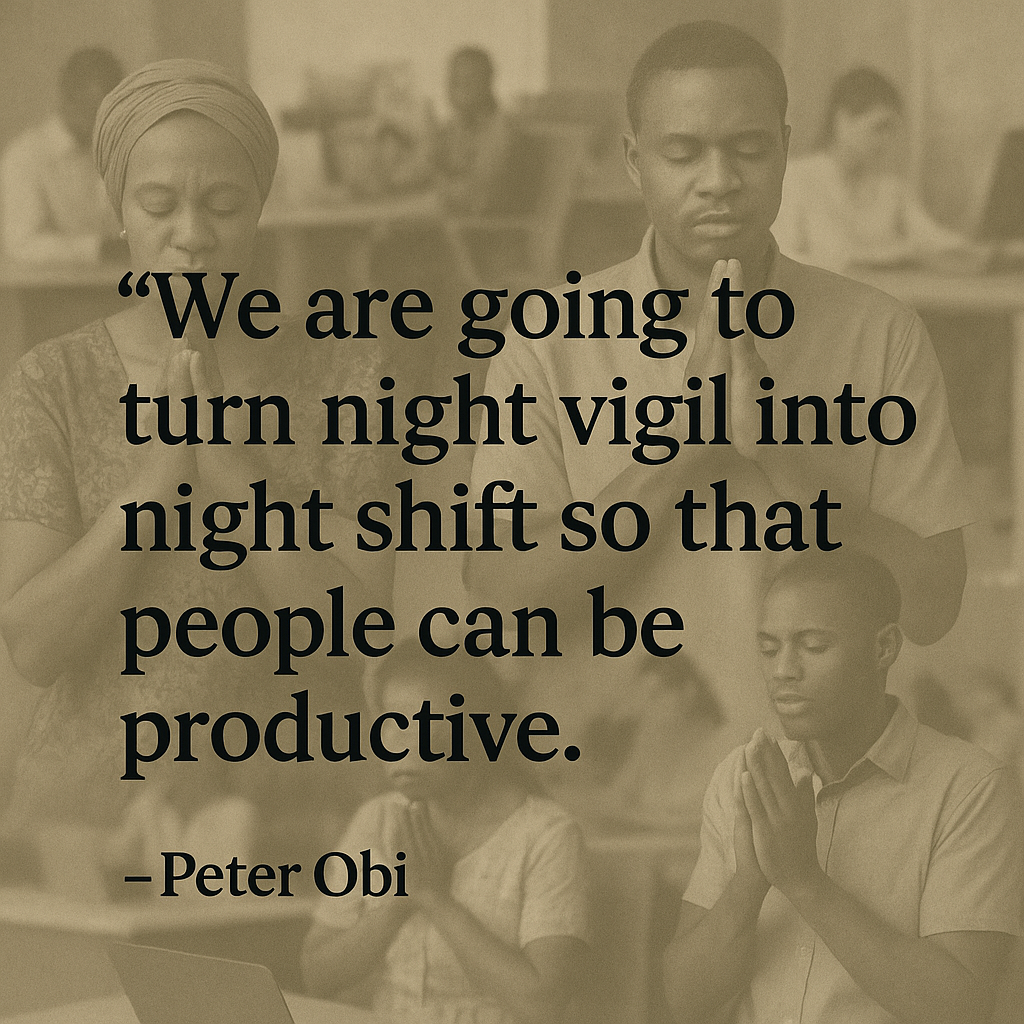
As Peter Obi rightly put it in a 2024 podcast appearance, “We are going to turn night vigil into night shift so that people can be productive.” His statement wasn’t an attack on faith—it was a challenge to balance spirituality with structure. Faith should energize our hustle, not excuse our idleness.
Now, I must admit—I write primarily from a Christian perspective. That’s my lived reality. But I have studied the Qur’an, attended the mosque once, and I have blood relatives who are Muslim. So while my words lean from one tradition, I speak with deep respect and shared concern across both. The productivity crisis is not about which religion—it’s about how we all practice.


This is not an attack on faith. Rather, it is a call to reclaim the transformative power of true spirituality—one that values discipline, diligence, and ethical leadership. After all, spiritual teachings, at their core, demand honesty, hard work, and service—virtues Nigeria desperately needs in every government office, school, hospital, and private sector boardroom.
We must also hold our religious leaders accountable. It is no longer enough to preach prosperity; there must be sermons on productivity. Religious institutions should teach time management, vocational skill-building, and financial discipline as spiritual acts. That’s how faith becomes a force for national transformation—not just personal deliverance.
Government and employers, too, must learn to integrate purpose-driven work ethics into their institutions. Research around the world shows that when workers feel their labor has meaning beyond survival, they perform better. In Nigeria, we already have the spiritual hunger—what we lack is a productive direction for that passion.
And perhaps, just perhaps, we should encourage more people to open their Bibles beyond Psalms. Many avoid the Book of Job, thinking it’s about employment pressure—not knowing it’s actually the oldest book of the Bible, and Job is a name, not a CV request!
Our spirituality should fuel a vision of excellence, not excuse mediocrity. Until that shift happens, we’ll keep praying—but remain unproductive.
#FaithAndProductivity #PeterObi #NightShiftNigeria #NewspotOpEd